If you’ve been posting regularly and still aren’t getting traffic, leads, or sales — the issue isn’t that you need to “show up more.”
That advice sounds responsible. It feels productive.
It’s also the reason most small businesses stay stuck.
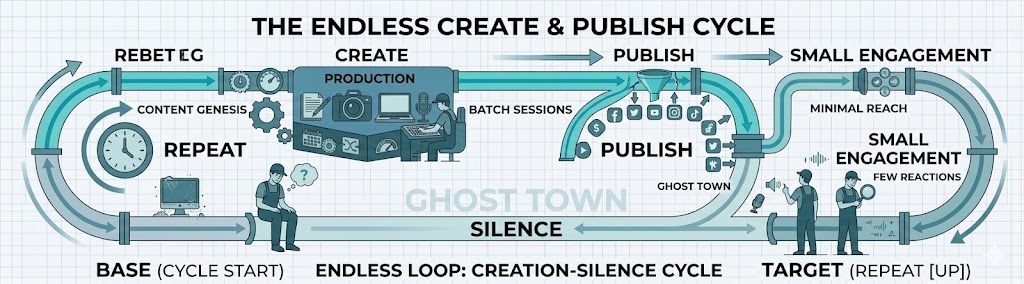
Because here’s what actually happens: You sit down. You write the post. You edit the video. You format the carousel. You hit publish. And then… nothing.
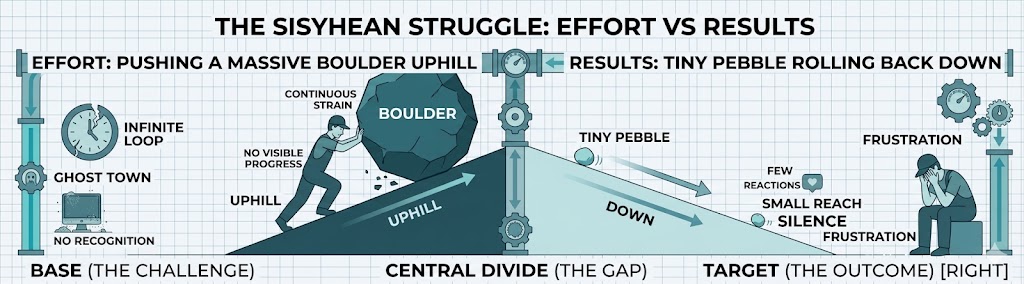
A few likes. Maybe a comment. Usually from people who already know you. But no discovery. No inbound traffic. No consistent leads.
Just effort with no return.
Most people’s first instinct is to blame themselves — I need to be more consistent, I need to post more, I need to try harder. But that’s not the problem. And chasing that answer is exactly why the cycle never breaks.
In this article, I’ll show you why most small business content fails, what’s actually broken at the system level, and the exact shift that changes everything.
What "Trying to Be Consistent" Actually Looks Like
Let’s be honest about what the experience really is.
You’re not lazy. You’re not undisciplined. You’re not “bad at content.”
You sit down every week with good intentions, create something from scratch, post it, and watch it disappear within 24 hours. Then you do it again the following week. And the week after that.
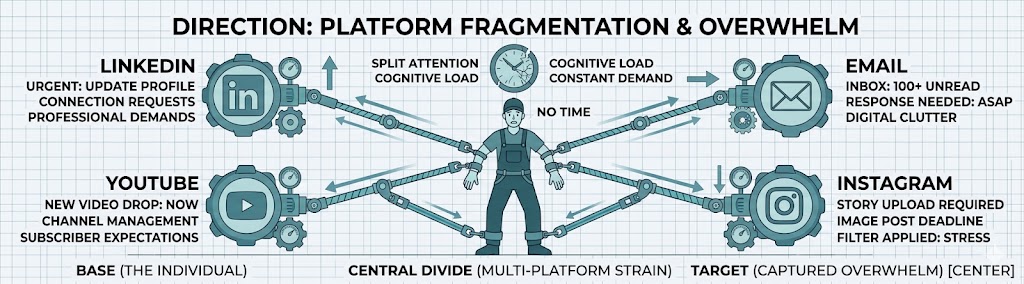
Every platform feels like a separate job. LinkedIn needs one thing, Instagram needs another, email is a completely different energy. So either you burn yourself out trying to do all of it, or you end up doing none of it consistently.
“You do not rise to the level of your goals. You fall to the level of your systems.” — James Clear — Atomic Habits
That’s not motivational fluff. That’s a precise diagnosis of what’s happening in your content.
You’re not failing at content. You’re operating a publishing system with no actual system behind it. The result is effort without amplification — you’re building, but nothing is carrying what you build into the market.
The Lie You Were Sold
“Consistency is king.”
It’s repeated so often it sounds like a law of physics. Post every day. Show up. Stay visible.
But consistency without structure doesn’t create growth. It creates activity. And activity without direction is just noise.
According to HubSpot’s State of Marketing Report, only 29% of marketers actively use content marketing strategically. That means the majority are creating content without a clear system — and wondering why results are flat.
You can post every day for a year and still be invisible if there’s no system behind what you’re doing. Because content doesn’t work based on how often you show up. It works based on how it flows
The fire has to exist first. And right now, most small businesses are throwing gasoline at empty air.
The Real Reason Most Small Business Content Fails
Here’s the belief shift that changes everything:
You don’t have a content problem. You have a flow problem.
Most content strategies fail for one reason: they were never designed as systems. They’re habits. They’re bursts of motivation. They’re disconnected actions. So instead of compounding, everything resets every time you open a blank page.
The difference between content that compounds and content that disappears isn’t quality.
It’s design.
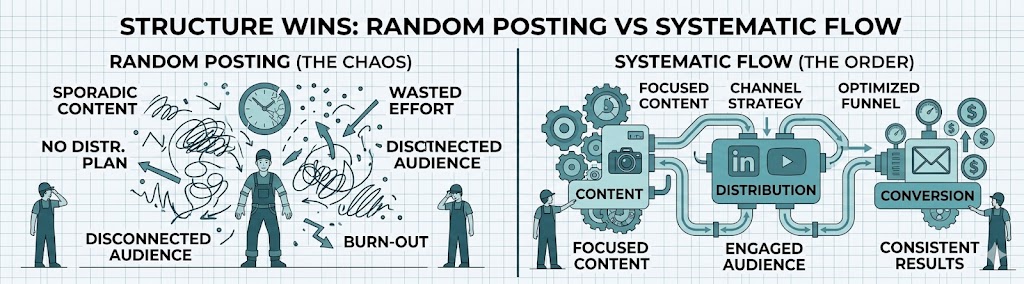
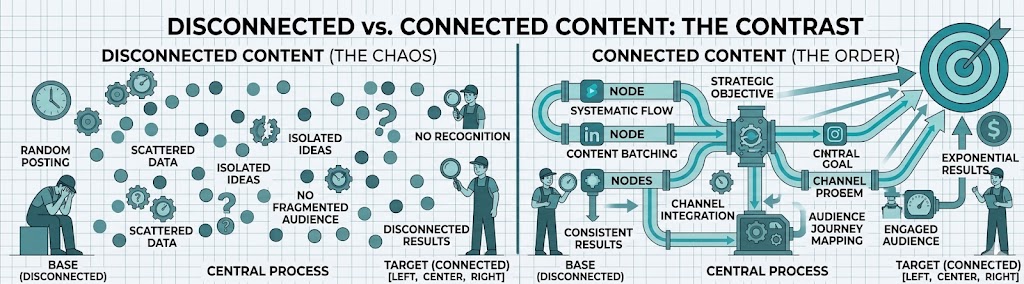
Disconnected content looks like:
Random posts with no keyword intent
No core topic structure
No repurposing workflow
No long-form anchor asset
No clear CTA path
No distribution strategy
A connected content system looks like:
One core topic per week
One long-form authority asset as the foundation
Multiple repurposed distribution assets
Each platform assigned a specific role
All roads leading back to a lead magnet, offer, or next step
Content that compounds over time
Same effort. Completely different outcome.
The 5 Reasons Most Small Business Content Fails (And What to Do Instead)
Reason 1: You’re Creating Posts, Not Assets
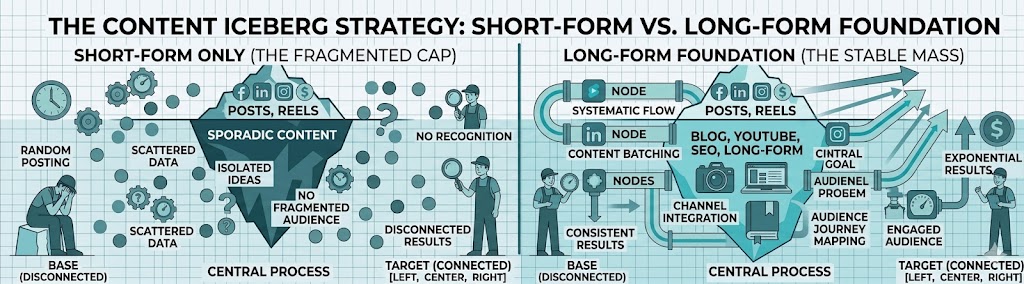
Most small businesses live entirely in short-form content. Posts. Reels. Quick updates.
The problem? These are distribution fragments, not foundations.
Short-form content relies on immediate algorithmic visibility, decays within hours, doesn’t build search presence, and doesn’t stack. You’re producing content that disappears instead of content that accumulates.
“The best content doesn’t just attract attention — it compounds value over time.” — Rand Fishkin — SparkToro
The shift: Stop starting with posts. Start with Core Assets.
A Core Asset is a long-form blog post, a YouTube video, or any structured piece of content that solves a real problem in depth. This becomes the source code for everything else — one idea, built properly, then transformed into multiple outputs.
The question changes from “What should I post today?” to “What asset am I building this week?” That question changes everything.
According to HubSpot’s marketing data, website and SEO content consistently ranks as the number one ROI-generating channel — above social, above paid ads. Long-form content that ranks isn’t just content. It’s infrastructure.
Reason 2: You’re Treating Every Platform Like a Separate Job
Most creators approach platforms like separate responsibilities. Now LinkedIn. Now Instagram. Now email. Now YouTube.
Each one requires new ideas. New formatting. New energy. This is where burnout starts quietly — because you’re not scaling effort, you’re duplicating it.
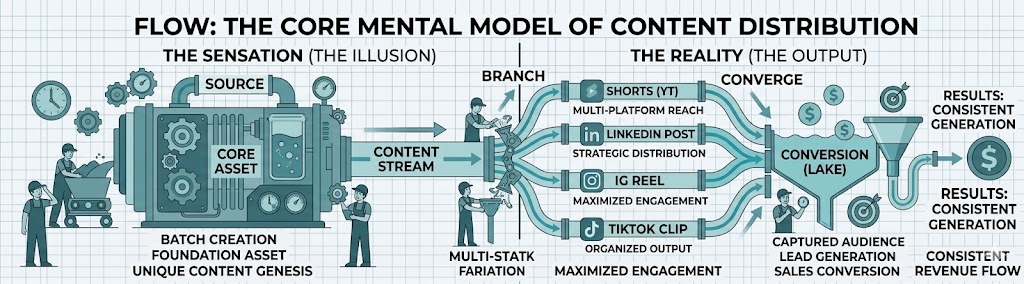
The shift: Think like a refinery, not a content creator.
You don’t invent fuel every time. You refine it.
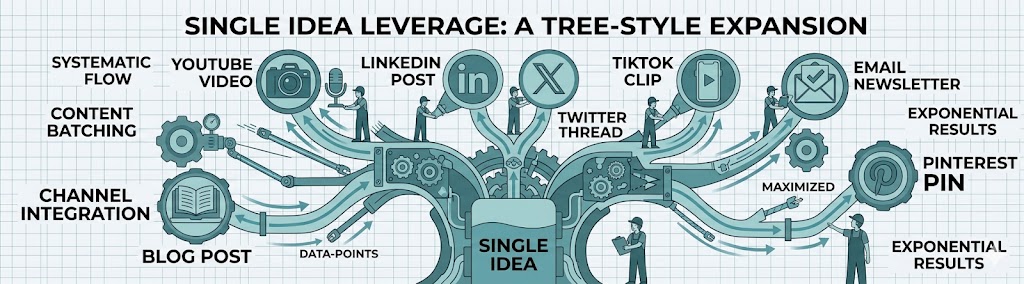
One Core Asset becomes:
Blog → authority and SEO
YouTube → search and depth
LinkedIn posts → insight extraction
Short-form clips → attention capture
Pinterest → visual discovery
Email → direct conversion
Same idea. Multiple formats. Structured output. One input → multiple outputs. Anything else is inefficiency disguised as hustle.
HubSpot’s research shows that only 48% of marketers currently repurpose content across platforms — meaning over half are still creating from scratch every single time. That’s not a volume problem. That’s a leverage problem.
Reason 3: You’re Publishing for Attention Instead of Intent
This is where most people drift without realizing it. They see what’s trending. They copy formats. They chase visibility.
But attention without intent is unstable — it gives you views without buyers, traffic without direction, reach without relevance.
Content that people are actively searching for attracts people who are already looking for a solution. You’re not interrupting them. You’re meeting them mid-search.
Here’s a data point worth sitting with: up to 60% of Google searches end without a click, according to coverage of HubSpot’s INBOUND report. That means even great content doesn’t guarantee traffic anymore — unless it’s deliberately designed around intent and structured for discoverability.
Reason 4: There’s No Path From Content to Conversion
Most content ends like this: the reader finishes, they nod, they leave. Not because they didn’t find value. Because there was no direction.
Attention leaks by default. If you don’t guide it, it disappears.
The shift: Every piece of content needs a job.
Not “get likes.” Not “build awareness.” A real job: move the reader to the next step.
A lead magnet
A checklist
A deeper piece of content
An email list
HubSpot’s ROI Report shows that businesses using structured content systems with clear conversion paths generate up to 3x more inbound leads. The content itself was often identical — the system around it wasn’t.
Reason 5: You’re Not Building a System That Compounds
Most businesses treat content like a timeline.
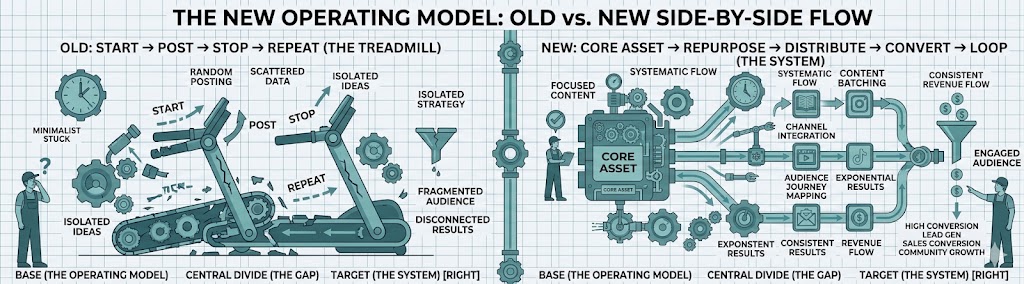
Post → disappears → repeat.
Which means you’re always starting from zero. That’s not a strategy. That’s a treadmill.
The shift: Treat content like infrastructure. You are building a library, not a feed.
A body of work that ranks, gets discovered, gets reused, and improves over time. Old content isn’t dead — it’s underutilized. Update it. Repackage it. Redistribute it. Build once. Optimize forever.
According to Content Marketing Institute research, 74% of marketers say content marketing generates leads, and 49% say it directly drives revenue. The key word is marketing — not posting.
There’s a system behind those results.
What Happens When You Fix the System: Real Proof
Theory is useful. Proof is better.
Case Study 1: 325% Traffic + 450% Revenue in 6 Months
A small business in a competitive education niche shifted from random posting to evergreen, search-driven content built around intent.
This is the Core Asset model in the wild. They didn’t get louder — they got structured.
Case Study 2: 347% Traffic Growth + 42% Conversion Increase
Another business was producing consistent content — but flat results.
What changed? They replaced random publishing with a structured strategy, aligned content with search intent, and built authority through topic depth. +347% organic traffic, +42% conversions.
Consistency wasn’t the issue. Structure was. Same effort. Different system. Completely different outcome.
Case Study 3: 100% Traffic Growth + 60% Lower Customer Acquisition Cost
A small business relying heavily on paid ads switched to intent-based SEO content and built a sustainable organic system.
When content becomes a system: traffic compounds, costs drop, and the quality of leads increases.
The pattern across all three:
Before
After
Random posting
Structured system
Short-term content
Evergreen assets
Attention chasing
Intent targeting
Publishing only
Distribution + architecture
Linear effort
Compounding growth
None of these wins came from posting daily or “being consistent.” They came from building a system that moves content from creation → distribution → conversion.
What This Looks Like in Practice
Old workflow:
Start from zero every day
Create disconnected posts
Burn out by mid-week
No measurable growth
New workflow:
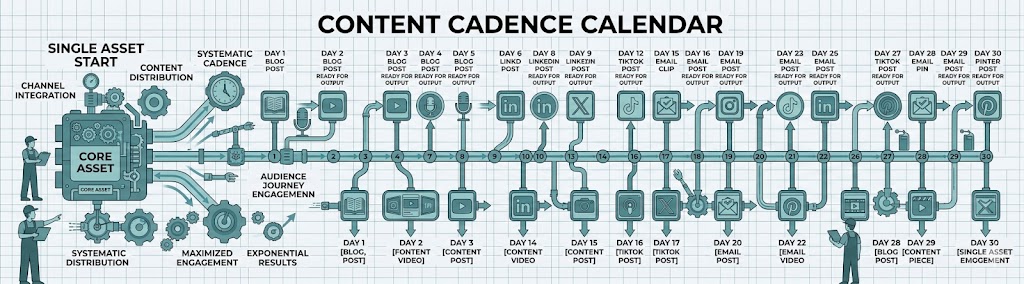
One idea → built into a Core Asset (blog post + YouTube video)
That asset → broken into 10+ outputs
All outputs → distributed intentionally over 30 days
All traffic → directed somewhere specific
For a topic like this one, a single weekly asset becomes:
LinkedIn Post 1: Contrarian insight
LinkedIn Post 2: Mini framework
YouTube Short 1: Hook clip
YouTube Short 2: Diagnostic clip
Pinterest Pin 1: “5 reasons your content isn’t working”
Pinterest Pin 2: Small business content system checklist
Quora Answer: Intent-matching Q&A
Email: “You don’t need more content. You need a system.”
One topic. One week of creation. 10+ pieces of content distributed over 30+ days.
That’s not hustle — that’s leverage.
Stop Asking "How Can I Post More?"
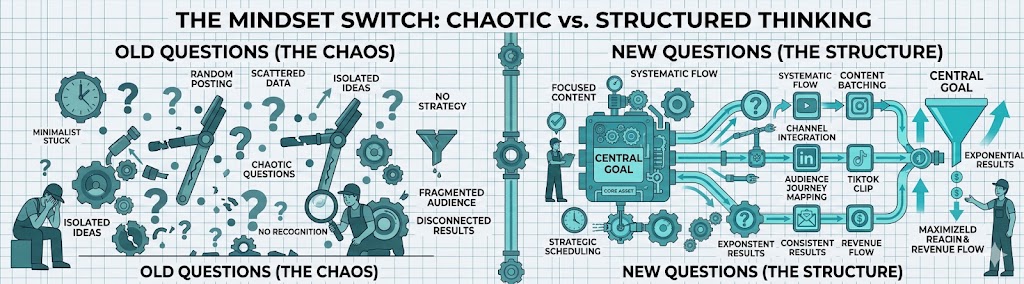
Instead of asking:
“How do I stay consistent?”
“What should I post today?”
“Why isn’t this working?”
Start asking:
“What Core Asset am I building this week?”
“How does this support search, trust, and traffic?”
“How can one idea become multiple assets?”
“Where does this content lead?”
Those are system questions. And systems are what scale.
Small business content fails when it’s treated like a posting habit. It starts working when it becomes a publishing system.
Why does my content get no traffic even when it's good?
Quality alone isn’t enough. Without distribution and search intent, your content never reaches the right people. Good content unseen produces the same result as bad content.
What is a content system for a small business?
A content system is a repeatable workflow that turns one idea into multiple pieces of content, distributes them across platforms, and connects them to a conversion goal. It replaces guesswork with process.
What is a "Core Asset" in content marketing?
A Core Asset is a long-form piece of content (blog post, video, guide) that acts as the foundation for all your weekly content. Everything else — social posts, shorts, pins, emails — is repurposed from it.
How do I turn one piece of content into multiple posts?
Start with a Core Asset, then extract: key ideas for social posts, short clips for reels or Shorts, summaries for email or LinkedIn, and visuals for Pinterest. One idea becomes 8–15 outputs without reinventing anything.
Is it better to post daily or focus on fewer high-quality posts?
Fewer, high-quality posts win — if they’re distributed properly. One strong Core Asset per week, distributed strategically over 30 days, is more effective than daily low-impact posts.
What is the difference between attention content and intent content?
Attention content entertains or interrupts. Intent content solves problems people are actively searching for. Intent content drives traffic and conversions. Attention content drives likes.
How long does it take for content marketing to work?
Content systems typically take 3–6 months to build meaningful momentum. The key difference is that results compound over time instead of resetting every week.
What is the fastest way to improve my content results?
Stop creating more content. Instead: build one Core Asset per week, repurpose it into multiple formats, distribute it consistently, and connect it to a clear conversion path. That’s where momentum starts.
The System That Fixes It
You don’t need more ideas. You don’t need more discipline. You don’t need to try harder.
You need structure.
Because right now, your effort is leaking in every direction. Every post you create and forget, every idea you don’t repurpose, every piece of content with no CTA — that’s compounding waste instead of compounding growth.
When you build the system:
Output becomes predictable
Traffic becomes consistent
Growth becomes measurable
And you stop being invisible — not because you got louder, but because you built something that carries your work further than you can on your own.
Stage 1 — Creation Engine: Turn ideas into structured, repeatable content instead of starting from scratch every week.
Stage 2 — Distribution Engine: Move content through channels intentionally — search-driven content to Google and YouTube, social-driven content to LinkedIn and short-form, visual discovery to Pinterest.
Stage 3 — Conversion Engine: Turn traffic into leads, and leads into buyers through clear paths, not hope.
Create → Distribute → Convert. That’s the machine. That’s what your content has been missing.
Ready to stop starting from scratch every week? The DIY Systems Pack is the exact framework built to help small businesses go from scattered effort to structured output — one Core Asset at a time.
To provide the best experiences, we use technologies like cookies to store and/or access device information. Consenting to these technologies will allow us to process data such as browsing behavior or unique IDs on this site. Not consenting or withdrawing consent, may adversely affect certain features and functions.
Functional
Always active
The technical storage or access is strictly necessary for the legitimate purpose of enabling the use of a specific service explicitly requested by the subscriber or user, or for the sole purpose of carrying out the transmission of a communication over an electronic communications network.
Preferences
The technical storage or access is necessary for the legitimate purpose of storing preferences that are not requested by the subscriber or user.
Statistics
The technical storage or access that is used exclusively for statistical purposes.The technical storage or access that is used exclusively for anonymous statistical purposes. Without a subpoena, voluntary compliance on the part of your Internet Service Provider, or additional records from a third party, information stored or retrieved for this purpose alone cannot usually be used to identify you.
Marketing
The technical storage or access is required to create user profiles to send advertising, or to track the user on a website or across several websites for similar marketing purposes.