
“Only 40% of marketers have a documented content strategy, yet those who do are significantly more effective.”
Source: HubSpot State of Marketing Report
Link: https://www.hubspot.com/state-of-marketing
You have the tools. You have the spreadsheet. You might even have a color-coded Trello board or a meticulously organized Notion dashboard.
You know exactly what day you’re supposed to post on Instagram. You have a slot reserved for your weekly LinkedIn update. You have a content calendar.
And yet, despite this “consistency,” your content efforts still feel… random.
🟠 HubSpot
“The most successful content marketers are those who document their strategy and align it with business goals.”
Source: HubSpot State of Marketing Report
🔗 https://www.hubspot.com/state-of-marketing
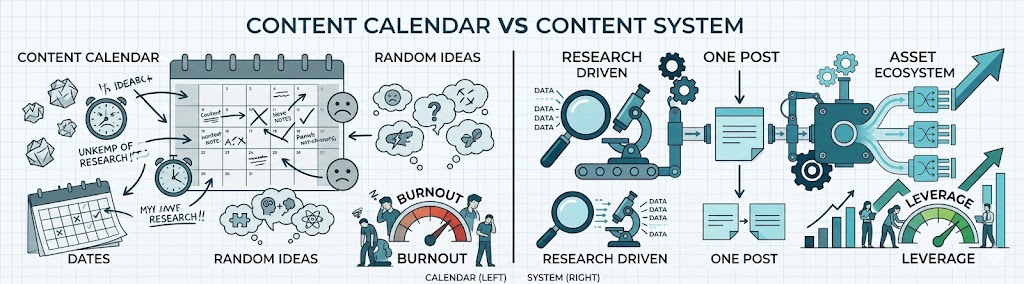
You sit down to create and stare at a blank screen. You scramble for ideas twenty minutes before a deadline. You feel like you are on a hamster wheel—running constantly, producing daily, but getting nowhere specific. The leads aren’t coming in consistently. The asset library isn’t growing.
You are busy, but you aren’t building.
Here is the uncomfortable truth that most marketing gurus won’t tell you: The problem usually isn’t your discipline.
The problem is your architecture.
You are trying to build a house with nothing but a calendar. You know when you want the walls to go up (Tuesday), but you don’t have the blueprints, the materials, or the construction crew to make it happen.
If your content feels chaotic, disconnected, or exhausting, you likely don’t have a calendar problem. You have a system problem.
Let’s fix that.
“Without a documented plan, content efforts can become inconsistent, unfocused, and difficult to measure.”
Source: HubSpot Content Marketing Strategy Guide
🔗 https://blog.hubspot.com/marketing/content-marketing-plan
WHAT A CONTENT CALENDAR ACTUALLY DOES
Before we tear down the idea of a content calendar, let’s give credit where credit is due. A content calendar is not evil. In fact, it is a necessary component of a mature business.
A content calendar is a visibility tool. Its primary job is to answer the question: “When does this go live?”
For a small business owner, a good calendar helps you:
- Schedule publication dates: You know that every Tuesday at 10:00 AM, an email goes out.
- Coordinate campaigns: You can see that your product launch aligns with a series of blog posts.
- Maintain cadence: It prevents you from posting five times in one day and then going silent for three weeks.
- Gain clarity: At a glance, you can see what is queued up for the month.
If you are running a blog that is already thriving, or you have a team of writers handing you finished articles, a calendar is perfect. It’s the logistical layer of your operation.
But a calendar is incomplete.
To use a construction analogy: A calendar tells you the framing crew is arriving on Monday. It does not tell you if you have the lumber, if the blueprint is accurate, or if the foundation has been poured.
If you only have a calendar, you know when you are supposed to produce, but you haven’t solved the struggle of what to produce or how to get it done efficiently.
A calendar is a planning layer. It is not the engine that drives your marketing.
🔵 Content Marketing Institute (CMI)
“A documented content strategy is one of the key factors that separates successful content marketers from their less successful peers.”
Source: Content Marketing Institute Research
🔗 https://contentmarketinginstitute.com/research/
Case Study 1 — From Random Content → Structured Strategy
Result:
- +347% organic traffic
- +42% conversion rate
- Clear authority positioning
Summary:
A B2B SaaS company was publishing content consistently but seeing little traction. After shifting to a structured content strategy with topic clusters, internal linking, and repurposing workflows, they increased organic traffic by 347% and improved conversions by 42% within 12 months.
🔗 Source: https://www.webbb.ai/blog/case-study-content-strategies-that-increased-traffic
“60% of the most successful content marketers have a documented strategy, compared to just 21% of the least successful.”
Source: Content Marketing Institute
Link: https://contentmarketinginstitute.com/articles/research-b2b-content-marketing/

WHY A CONTENT CALENDAR FAILS ON ITS OWN
This is where the frustration sets in. Most business owners treat their content calendar like a strategy. They fill in the slots—“Tuesday: Blog Post. Thursday: Instagram Reel.”—and expect results.
But when the day arrives, they hit a wall. Why? Because a calendar is passive. It sits there waiting for you to fill it. It does not solve the five critical gaps that cause content marketing to fail:
- The Idea Gap (What do I say?)
A calendar gives you a slot that says “Write Blog Post.” It does not give you the topic. When you rely solely on a calendar, you are forced to conjure ideas out of thin air. This leads to “writer’s block,” which is actually just “lack of research.”
- The Workflow Gap (How do I get it made?)
Knowing you need to film a video on Thursday doesn’t help if filming a video takes you six hours because you don’t have a script, a setup, or a process. A calendar manages time; it doesn’t manage the steps of production.
- The Repurposing Gap (How do I use this again?)
A calendar views a post as a one-off event. “Posted on Tuesday. Done.” It doesn’t ask: How do I turn this blog post into a newsletter? How do I turn this newsletter into a tweet thread? Without this, every day is Day 1. You are constantly starting from scratch.
- The Distribution Gap (Where does it go?)
A calendar might tell you to post on LinkedIn. But does it tell you to pin that post to your Pinterest board? Does it tell you to update your sales team with the talking points? A calendar often siloes your content rather than broadcasting it.
- The Conversion Gap (What is the point?)
This is the most fatal flaw. A calendar helps you publish. It does not ensure your content leads to a sale. You can be perfectly consistent and perfectly broke if your content has no logical bridge to an offer.
The Symptoms of “Calendar-Only” Marketing: If you rely solely on a calendar, you likely experience these symptoms:
- The Blank Page Stare: You dread the scheduled block because you don’t know what to fill it with.
- The Last-Minute Rush: You’re scrambling at 11:00 PM the night before to hit your publish date.
- The Disconnected Offer: Your content gets likes, but nobody buys.
- The Burnout Cycle: You feel like you are running on a treadmill, creating content just to delete it and make more next week.
The core issue is that a calendar manages dates, but a business owner needs to manage outcomes.
Case Study 5 — Content Engine vs Random Posting
Result:
- +266% traffic
- 5X lead growth
- Content becomes #1 growth channel
Datails:
A B2B company rebuilt its content approach into a structured content engine, resulting in 266% traffic growth and a 5X increase in leads, making content its primary growth channel.
🔗 Source: https://www.yesoptimist.com/content-marketing-case-studies/
“Content marketing success comes from building a repeatable, scalable process—not from random acts of content.”
Source: Content Marketing Institute
🔗 https://contentmarketinginstitute.com/articles/
WHAT A CONTENT SYSTEM ACTUALLY IS
So, what is the alternative? If a calendar isn’t the answer, what is?
You need a Content System.
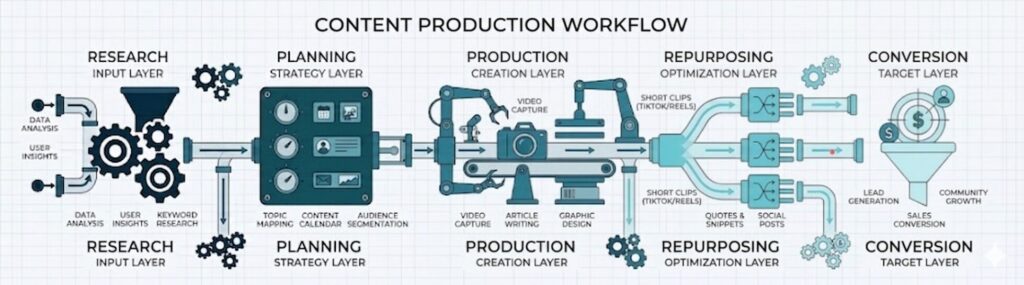
A Content System is a repeatable operating model for your marketing. It is not just a schedule of when things happen; it is the machine that manufactures what happens.
A true Content System connects the dots between:
- Research: Understanding your audience deeply.
- Strategy: Mapping content to the buying journey.
- Production: Efficient workflows to create assets.
- Repurposing: Maximizing the value of every idea.
- Conversion: Turning readers into customers.
Think of it like a kitchen in a restaurant.
- A Content Calendar is just the menu on the table. It tells you what is being served.
- A Content System is the entire kitchen operation: The inventory, the recipes, the prep work, the line cooks, and the expediter. It ensures that when an order comes in, the food gets out fast, tastes good, and makes the customer money.
When you have a system, content stops being a random act of creativity and becomes a predictable business asset. You stop asking, “What should I post today?” and start asking, “Where are we in the production cycle?”
A system creates reliability (it works every time), leverage (one effort creates multiple results), and alignment (every piece serves the business goals).
🟢 Ahrefs
“If you create content without a strategy, you’re just guessing—and guessing rarely leads to consistent traffic or results.”
Source: Ahrefs Blog
🔗 https://ahrefs.com/blog/content-strategy/
Case Study 4 — Content + Email System Integration
Result:
- 100,000+ search impressions
- 2,000+ visitors
- Hundreds of leads
Details:
By combining SEO-driven content with a structured email system, a business generated over 100,000 search impressions, 2,000+ visitors, and hundreds of new leads in just four months.
🔗 Source: https://resultris.com/case-studies/
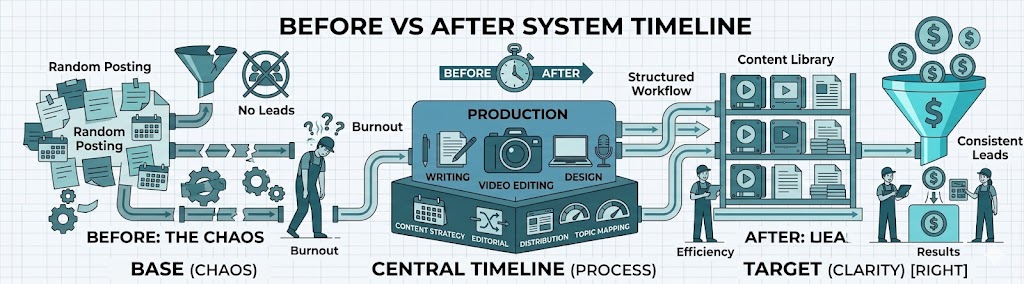
CONTENT CALENDAR VS CONTENT WORKFLOW VS CONTENT SYSTEM
To build this properly, we need to clarify the terminology. These three terms are often used interchangeably, but they represent three distinct layers of your operation. Confusing them is why most marketing efforts fall apart.
- Content Calendar (The “When”)
This is the top layer. It is the view of your publish dates.
- What it answers: What goes live and when?
- Example: “Tuesday, 10 AM: Publish Article A.”
- Content Workflow (The “How”)
This is the process layer. It is the step-by-step movement of an idea from a raw thought to a published asset.
- What it answers: What are the steps to create this?
- Example: “Idea Keyword Research → Outline → Draft → Edit → Design → Upload.”
- Why it matters: This solves the production bottleneck. It replaces willpower with checklists.
- Content System (The “Why” and “What Next”)
This is the architectural layer. It is the ecosystem that encompasses your research, your strategy, your workflows, your library, and your conversion paths.
- What it answers: Why are we creating this? How does it serve the audience? How do we reuse it? How does it generate revenue?
- Example: “We are targeting ‘Problem X’ because our audience is in the ‘Awareness Stage.’ We will create a blog post, which we will repurpose into an email sequence that drives traffic to our lead magnet.”
The Comparison:
- Calendar = A Schedule.
- Workflow = A Process.
- System = An Operating Model.
Most people try to fix a System problem (no leads, no strategy) by buying a Calendar tool (a new app). This is like trying to fix a broken engine by buying a nicer dashboard. You need to fix the engine first.

“Businesses that blog generate 67% more leads than those that don’t.”
Source: Demand Metric
Link: https://www.demandmetric.com/content/content-marketing-infographic
THE 5 LAYERS OF A REAL CONTENT SYSTEM
Now, let’s get into the nitty-gritty. If you are going to build a DIY Content System that actually works, you need to build these five layers. This is the framework that transforms random posting into a revenue-generating machine.
Layer 1: Research (The Input)
You cannot guess your way to success. A robust system starts with knowing your audience better than they know themselves.
- Audience Deep Dive: What keeps them up at night?
- Search Intent: Where and how are they searching for solutions? Are they typing “how to” or “best tool for”?
- Problem Mapping: You must identify the specific problems they are trying to solve.
- System Component: A repository of customer questions, FAQs, and search data that feeds your idea bank.
Layer 2: Planning (The Strategy)
Once you know the problems, you must map them to the buying stage.
- Topic Clustering: Don’t just write random posts. Group keywords into clusters so you build authority on a subject.
- Buying Journey: Map content to the stage the customer is in.
- Awareness: “Why do I have this problem?”
- Consideration: “What are the solutions?”
- Decision: “Why should I choose you?”
- System Component: A Content Matrix that aligns topics to business goals.
Layer 3: Production (The Build)
This is where the workflow lives. You need templates, not blank pages.
- Format Selection: The system guides you to the right format. If your audience searches on Google, you write an article. If they hang out on TikTok, you film a video.
- Templates: Use outlines for blogs, script templates for video, and design templates for carousels.
- System Component: Standard Operating Procedures (SOPs) for creation.
Layer 4: Repurposing (The Multiplier)
This is how you stop the hamster wheel. One idea must become multiple assets.
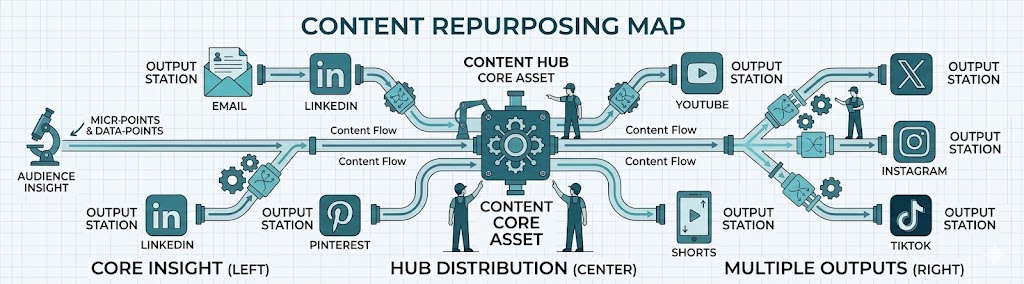
- The Content Ecosystem: A single core topic (like a blog post) is broken down into:
- 3 Tweets
- 1 LinkedIn Post
- 1 Instagram Carousel
- 1 YouTube Short
- 1 Email Newsletter
- System Component: A “Content Asset Stack” workflow.
Layer 5: Conversion (The Goal)
Content without a CTA is a hobby. A system ensures every piece has a job.
- The Bridge: How do you move them from the content to the offer?
- The Library: You store all assets in a searchable library so you can link back to them in future emails or sales conversations.
- System Component: A tracking system that connects content views to lead capture.
If even one of these layers is missing, your content marketing will feel fragile. You might publish consistently (Layer 1), but if you lack Conversion (Layer 5), you won’t make money. If you have great ideas (Layer 1) but no Production workflow (Layer 3), you will burn out.
“Great content isn’t about publishing more—it’s about publishing with purpose and aligning content with search intent.”
Source: Ahrefs Blog
🔗 https://ahrefs.com/blog/
Case Study 2 — Evergreen Content + System Thinking
Result:
- +325% traffic
- +450% revenue
Details:
An education company shifted from ad hoc publishing to a structured evergreen content strategy, resulting in a 325% increase in organic traffic and a 450% increase in revenue within 6 months.
🔗 Source: https://brandnewcopy.com/content-marketing-case-study/
HOW TO TELL IF YOU ONLY HAVE A CALENDAR
Let’s run a quick diagnostic. Be honest with yourself as you read through this checklist.
You probably only have a calendar (and not a system) if:
- The Blank Page Panic: You open your calendar, see “Post Today,” and have absolutely no idea what to write about because you didn’t do the research beforehand.
- The Silo Creator: You create your LinkedIn post, then separately create your email, then separately create your blog. They are all different topics.
- The Motivation Trap: You only create content when you “feel inspired.” A system relies on structure; a calendar relies on hope.
- The One-and-Done: You publish a piece of content and never look at it again. You don’t repurpose it, update it, or reuse it.
- The Disconnect: Your content gets engagement (likes/comments), but you have no clear path to turn that attention into a consultation or sale.
- The Tool Hoarder: You have five different tools for scheduling, but you still can’t get your content out on time because the tools don’t write the content for you.
If you checked three or more of these boxes, stop trying to optimize your calendar. You need to build a system.
“Repurposing content can increase content efficiency by up to 60%.”
Source: SEMrush Content Marketing Toolkit Study
Link: https://www.semrush.com/blog/content-marketing-statistics/
Want A FREE Version of The Content OS You Can Implement TODAY?

A SIMPLE STARTER CONTENT SYSTEM FOR SMALL BUSINESS OWNERS
You don’t need to hire an agency or buy expensive software to fix this. You can start building a system today with a simple 1-Week Operating Rhythm.
Here is a framework you can implement immediately.
The “Batch & Flow” Weekly Rhythm
Monday: Input & Research (The “What”)
- Task: Review your audience research. Pull 3 questions they asked this week or 3 problems they need solved.
- Action: Choose 1 Primary Topic for the week that addresses one of these problems.
- Goal: By the end of Monday, you know exactly what you are talking about. No blank pages later in the week.
Tuesday: Structure (The “How”)
- Task: Build the framework for your content.
- Action: Create an outline for your long-form content (blog or video). Sketch the headlines for your social posts.
- Goal: The heavy thinking is done. You are just filling in the blanks.
Wednesday: Production (The Build)
- Task: Create the Core Asset.
- Action: Write the article or record the video. Do not edit yet. Just get the bulk of the content out of your head.
- Goal: A finished (rough draft) core asset.
Thursday: Repurposing (The Multiplier)
- Task: Slice and dice the Core Asset.
- Action:
- Pull 3 key quotes for LinkedIn/Twitter.
- Create a 5-slide carousel summarizing the points.
- Write a short email blurb linking to the core asset.
- Goal: Turn 1 hour of work into 5 pieces of content.
Friday: Distribution & Review (The Release)
- Task: Publish and Schedule.
- Action: Upload your content. Schedule the social posts. Hit send on the email.
- Goal: Clear the deck for the weekend.
System Check: Next week, don’t start from scratch. Look at what you did this week. Can you answer a follow-up question? Can you go deeper on point #2? This creates a feedback loop.
Case Study 3 — Content System = Compounding Growth
Result:
- +195% traffic in 1 year
- +900% over 3 years
Details:
A 3D printing company transformed its underperforming blog into a lead-generation engine by implementing a structured content strategy focused on audience intent and consistency, resulting in 195% traffic growth in one year and 900% over three years.
🔗 Source: https://purevisibility.com/strategic-blogging-increases-traffic/
EXAMPLE: ONE TOPIC BECOMES A FULL CONTENT ASSET STACK
Let’s see this system in motion. We are going to take the topic of this very article—Content Calendar vs Content System—and show you how a System Builder turns it into an asset stack.
The Input (Research): We notice that our audience is frustrated with “inconsistency.” They think they need more discipline, but we know they need better architecture.
The Core Asset:
- Blog/Article: “Content Calendar vs Content System: Why Most Small Business Content Still Feels Random” (The piece you are reading now).
The Repurposing Workflow (How we slice it):
- The YouTube Video: We record a 10-minute video summarizing the 3 layers (Calendar, Workflow, System).
- Short-Form Video (Reels/TikTok): We take a 30-second clip: “Stop asking what to post. Start building a system.”
- The LinkedIn Carousel: We design a 10-slide PDF titled “5 Signs You Only Have a Calendar, Not a System” (based on Section 6).
- The Twitter Thread: We tweet the “Symptoms Checklist” as a thread, asking followers to reply with their biggest struggle.
- The Email: We send a newsletter to our list: “Are you busy or effective? The difference between a calendar and a system.”
- The Lead Magnet: We offer a downloadable “Content Workflow Starter Kit” (the CTA at the end of this article).
- The Sales Bridge: At the bottom of the article and in the email, we link to the DIY Content OS for those who realize they can’t build this system alone.
The Result: We spent the bulk of our effort researching and writing one strong article. But because of the system, we populated an entire week’s worth of content across five different platforms, all driving traffic back to our business.
That is leverage.
COMMON MISTAKES WHEN BUILDING A CONTENT SYSTEM
As you go to build your own system, avoid these pitfalls that plague DIY builders.
- Tool Obsession Do not spend three weeks setting up a complex Airtable or ClickUp dashboard. A system is defined by the process, not the software. You can run a world-class content system on index cards. Start with the workflow; add the tools later.
- The “All Platforms” Trap Do not try to build a system for LinkedIn, Instagram, TikTok, Pinterest, and your Blog all at once. Pick one primary platform and one owned channel (like email). Build the system there. Once it works, clone it for other platforms.
- Starting with Posting If you start your system by asking, “When should I post?” you are lost. You must start by asking, “Who am I helping and what is their problem?” Posting is the last step, not the first.
- Creating Without a CTA Never publish a piece of content without asking: “What do I want them to do next?” If you don’t tell them, they will scroll past. Your system must include a step for designing the Call to Action.
- Confusing Consistency with Effectiveness Posting garbage every day is consistent, but it’s not effective. A system prioritizes quality and strategy over mere volume.
“42% of marketers say creating content consistently is their biggest challenge.”
Source: Wyzowl Video Marketing Statistics
Link: https://www.wyzowl.com/video-marketing-statistics/
WHAT TO DO NEXT
If you have read this far, you realize the gap. You see why your content has felt random despite your best efforts to organize it.
You don’t need a bigger calendar. You don’t need more discipline. You don’t need to “hustle harder.”
You need an operating model.
You need to move from being a Content Creator (someone who makes stuff) to a Content System Builder (someone who builds a machine that makes stuff for you).
Here is your action plan for this week:
- Stop looking at your empty calendar slots with guilt.
- Start with research. Find one problem your audience has.
- Build one piece of core content (an article or video).
- Slice that content into three smaller pieces for social media.
- Connect it all to an offer.
This is the beginning of your system.
READY TO INSTALL YOUR CONTENT OS?
Building a system from scratch takes time. You have to design the workflows, create the templates, and figure out the tech stack.
But what if you could skip the line?
What if you could install a pre-built Content Operating System that already has the research workflows, the topic cluster maps, and the repurposing logic built-in?
We have created the DIY Content OS specifically for the business owner who is tired of the random content grind.
Download the DIY Content Workflow Starter Kit. Get a taste of the system today. We’ve packaged the essential components of the DIY Content OS into a starter kit to help you visualize your new workflow.
- The 1-Page Workflow Map: See the difference between your current calendar and a real system.
- The Weekly Operating Rhythm: A plug-and-play schedule for your content week.
- The Repurposing Matrix: Never wonder how to reuse a post again.
- The Simple System Audit: Diagnose exactly where your current setup is broken.
Click Here to Download the Workflow Starter Kit
Take the 3-Minute Systems Audit Not sure if you even need a full system yet? Take our quick 3-minute audit to identify your biggest content bottleneck.
If you look at the Starter Kit and think, “I need this whole thing running for me right now,” then you are ready for the Full DIY Content OS.
Stop treating your content like a chore on a to-do list. Turn it into the engine that powers your business.
Install the system. Build the library. Grow the audience.
CASE STUDY — FROM RANDOM BLOG POSTS TO A LEAD ENGINE
How One Company Turned Scattered Content Into 900% Growth
At first glance, their content operation looked familiar.
They were publishing regularly.
They had a blog.
They had topics.
They even had a loose calendar.
And yet… nothing was happening.
Traffic was flat.
Leads were inconsistent.
Content felt like effort without return.
Sound familiar?
The Problem: Activity Without Architecture
The company (a 3D printing business) wasn’t lazy. They were active.
But their content had three fatal flaws:
- Topics were chosen randomly
- Posts weren’t connected to each other
- There was no clear path from content → conversion
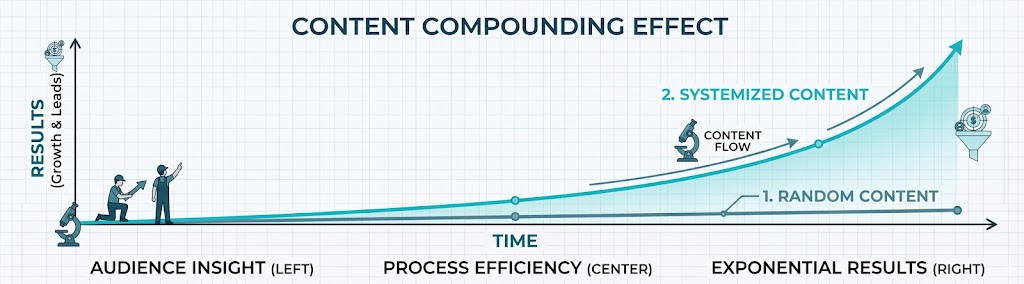
Each article lived in isolation. No ecosystem. No compounding effect. Just… posts.
They didn’t have a content calendar problem.
They had a system problem.
The Shift: Building a Content System
Instead of publishing more, they changed how they operated.
They moved to a structured content strategy built on:
- Audience Intent First
Every piece of content started with a real customer question or search query. - Topic Clusters Instead of One-Off Posts
Content was grouped into themes, allowing them to build authority instead of scattering attention. - Internal Linking & Content Ecosystem
Articles were connected, guiding readers deeper instead of letting them bounce. - Consistent Workflow
They implemented a repeatable process for research, creation, and publishing.
In other words…
They stopped creating content randomly and started building a content machine.
The Result: Compounding Growth
The shift didn’t create overnight magic.
It created momentum.
- 📈 +195% traffic in the first year
- 🚀 +900% traffic growth over three years
Source: https://purevisibility.com/strategic-blogging-increases-traffic/
But the real transformation wasn’t just traffic.
It was predictability.
Content stopped being a guessing game and became a growth engine.
The Insight: Systems Compound, Calendars Don’t
Here’s what makes this case study powerful:
They didn’t:
- Post more frequently
- Hire a massive team
- Use more tools
They simply:
👉 Connected their content
👉 Structured their ideas
👉 Built a repeatable system
A calendar would have told them when to post.
A system showed them:
- what to create
- why it matters
- how it connects
- where it leads
The Takeaway for You
If your content feels like it disappears the moment you hit publish…
If every week feels like starting from zero…
If you’re busy but not building…
Then you’re exactly where they were.
And the solution isn’t more discipline.
It’s the same shift:
👉 From isolated posts → connected assets
👉 From random ideas → structured strategy
👉 From calendar → system
This is the difference between:
- A business that does content
vs - A business that builds a content engine
One produces posts.
The other produces outcomes.
📊 Real-World Proof: Systems Beat Calendars
- +347% traffic from structured content strategy
- +450% revenue from evergreen content systems
- +900% long-term growth from strategic blogging
- Hundreds of leads from integrated content + email systems
👉 Pattern:
Not more content.
Not better tools.
Better systems.
FAQ
What is the main difference between a content calendar and a content system?
A content calendar schedules when content is published. A content system defines what to create, why it matters, how it’s produced, and how it drives results.
Can a content calendar still be useful?
Yes. A calendar is essential for organization, but it should sit on top of a system, not replace one.
Why does my content feel random even though I post consistently?
Because consistency without strategy leads to disconnected content that doesn’t build momentum or drive outcomes.
Do small businesses really need a content system?
More than large businesses. You have fewer resources, so every piece of content must work harder.
How long does it take to build a content system?
You can create a basic system in a week, but refining it into a high-performing engine takes 4–8 weeks.
What is the first step in building a content system?
Audience research. Without understanding problems, everything else becomes guesswork.
How often should I create content in a system?
Consistency matters, but quality and alignment matter more. Even one strong weekly asset can outperform daily random posts.
What is content repurposing?
Turning one core idea into multiple formats like articles, videos, emails, and social posts to maximize reach.
Do I need expensive tools to build a content system?
No. A simple workflow and clear process matter more than tools. You can start with Google Docs and spreadsheets.
How does a content system generate revenue?
By guiding users from awareness to decision through structured content that connects to offers.
What is a content workflow?
A step-by-step process that turns an idea into a published asset, removing guesswork and inefficiency.
Why do most content strategies fail?
Because they focus on output (posting) instead of outcomes (leads, sales, authority).
How do I know if my system is working?
You’ll see consistent content production, growing traffic, and clear pathways to conversion.
Should I be on every platform?
No. Start with one primary platform and one owned channel like email.
What is the biggest mistake people make?
Confusing activity with progress. Posting frequently does not equal building an asset.
Further Reading & Resources
📘 Reports & Research
- HubSpot State of Marketing
https://www.hubspot.com/state-of-marketing - Content Marketing Institute Annual Reports
https://contentmarketinginstitute.com/research/ - Demand Metric Content Marketing Research
https://www.demandmetric.com
📊 Data & Statistics
- SEMrush Content Marketing Stats
https://www.semrush.com/blog/content-marketing-statistics/ - Wyzowl Video Marketing Statistics
https://www.wyzowl.com/video-marketing-statistics/
📚 Guides & Deep Dives
- Ahrefs Blog (SEO + Content Systems)
https://ahrefs.com/blog - HubSpot Content Strategy Guide
https://blog.hubspot.com/marketing/content-marketing-plan - Backlinko Content Marketing Hub
https://backlinko.com/content-marketing
🎥 Videos & Visual Learning
- HubSpot YouTube Channel
https://www.youtube.com/@HubSpot - Neil Patel Marketing Channel
https://www.youtube.com/@neilpatel
🎧 Podcasts
- Content Inc. Podcast (Joe Pulizzi)
https://contentmarketinginstitute.com/podcast/ - Marketing School (Neil Patel & Eric Siu)
https://marketingschool.io
📈 Tools & Frameworks
- Google Trends (Research Layer)
https://trends.google.com - AnswerThePublic (Audience Questions)
https://answerthepublic.com - AlsoAsked (Search Intent Mapping)
https://alsoasked.com