
Most creators think the answer to their stagnation is simple: Post more content.
They believe their reach is shrinking because they aren’t loud enough. They think their engagement is low because they missed a day. They’re convinced that if they just grind harder, wake up earlier, and churn out more volume, the algorithm will eventually reward them.
But the real problem isn’t a lack of activity. It’s a lack of architecture.
You’re operating without a content system. You’re mistaking movement for progress. You’re engaged in frantic activity disguised as strategy.
“Without strategy, content is just stuff, and the world has enough stuff.” — Arjun Basu
Here’s the uncomfortable truth: You’re not building a business. You’re maintaining a hobby at scale. And until you understand the fundamental difference between posting content and building a content system, you’ll remain exhausted — not expanding.
Busy, not growing.
Let’s dismantle the chaos and create the solution.
The Chaos You're Currently Living In
You know the feeling. You sit down to create content and suddenly, the simplest task feels like climbing a mountain.
You’re staring at a blank screen, waiting for your brain to produce a brilliant insight like a vending machine with no power. So you start scrolling — ‘for inspiration.’
Five minutes becomes ten. Ten becomes twenty. Suddenly you’re analyzing your previous posts because you’ve run out of ideas to steal from yourself.
Your day is already packed. Clients. Admin. Sales calls. Deliverables. And yet here you are, trying to reinvent the wheel just to publish something before the algorithm goes cold.
So you post whatever you can come up with in the moment.
Some days it lands. Most days it doesn’t. And you have absolutely no idea why.
This is the hidden cost of operating without a system. When you rely on willpower, motivation, and random posting, you lose four critical things:
- No Compounding Effect — Each post exists alone, like a soap bubble that pops within 48 hours. Nothing stacks. Nothing builds on itself. You’re always starting from zero.
- No Assets Being Built — You’re creating ‘content moments,’ not content machines. An asset works for you while you sleep. A content moment demands your attention to exist.
- No Measurable Strategy — You don’t know what’s working. You don’t know why something performed well. You’re navigating without a compass, hoping the current takes you somewhere profitable.
- No Clarity, Which Means No Speed — Without structure, you overthink. Without a system, you waste time deciding instead of producing. Confusion is the ultimate tax on your time.
If this sounds familiar, it’s because you’ve been lied to. Your ‘content block’ was never the real issue. Your inconsistency is merely the symptom. The cause is structural.

The Truth Nobody Told You
Let’s make one thing absolutely clear:
- The problem isn’t inconsistency.
- The problem isn’t ideas.
- The problem isn’t the algorithm.
The real problem is that you’re operating without a system.
You don’t have a pipeline — you have isolated posts. You’re not building a content engine; you’re building content moments.
“Content marketing is a commitment, not a campaign.” — Jon Buscall
Posting Content Is Linear
Idea → Post → Done.
Repeat every day, forever. It’s a straight line that resets to zero every 24 hours. It depends entirely on mood, motivation, and mental capacity. If you’re tired, posting becomes a chore. If you’re busy, posting becomes impossible.
Linear creation equals burnout. It is a fragile, manual process that breaks the moment life gets in the way.
A Content System Is Cyclical
Idea → Creation → Distribution → Repurposing → Optimisation → Input Loop.
It feeds itself. Your future content becomes easier because your system gets smarter over time.
Cyclical creation = compounding growth.
This simple shift — from linear to cyclical — is the difference between people who create content forever and people who build machines that create content for them.
Big brands do this. Large agencies do this. But small business owners? Nobody ever taught them how to build the machine. They only taught them how to push the button.

What the Data Actually Says
This isn’t philosophy. It’s physics with a profit margin. Here’s what structured content systems produce when they replace random posting:
$2.77 ROI per $1 spent — The average return from content marketing (177% return). Systems produce returns, not just activity.
62% cheaper than outbound — Content marketing costs less and generates leads 6x more likely to convert.
13x more positive ROI — Businesses that blog consistently outperform those that don’t. Consistency + structure = exponential results.
The data doesn’t reward volume. It rewards systems.
The Framework: Posting vs. Systems
There are three core differences between posting content and building a content system. Once you see them, you can’t unsee them.
Difference #1: Inputs vs. Pipelines
Posting Content = Inputs.
Every day you need a new idea. Every day you need fresh creativity. One idea equals one output. You’re constantly hunting for resources.
A Content System = Pipelines.
In a system, one idea becomes multiple assets. We use a ‘One Core Asset’ model. One big idea turns into:
- 1 Long-form video
- 1 Blog post
- 2–4 Pinterest pins
- 2–3 LinkedIn posts
- 3–5 YouTube Shorts
- 2–3 Quora answers
- 1–2 Reddit posts/comments
- 1–2 Emails
“Avoid producing random acts of content. Your content should be intentional and map back to business objectives.” — Alex Rynne
One idea equals 12+ outputs. You don’t need more ideas. You need better pipelines.

Difference #2: Randomness vs. Repeatability
Posting = Motivationally Fragile.
If your process requires discipline, inspiration, or ‘being in the mood,’ it’s fragile by definition. You’ll fail whenever life becomes busy. And business is always busy.
Systems = Operationally Reliable.
Systems don’t care how you feel. Systems don’t burn out. A system gives you:
- A clear process (the Blueprint)
- A predictable workflow (the Weekly Rhythm)
- A structure that reduces thinking
- A repeatable path that moves without you
Difference #3: Dead Posts vs. Active Assets
Posting = Dead in 48 Hours.
Most content spikes, then disappears. It doesn’t live anywhere. It doesn’t drive traffic. It doesn’t compound. You’re writing on water.
Systems = Content That Lives.
When content becomes an asset, it is:
- Searchable: It answers questions people are asking right now on Google or Quora.
- Repurposable: It can be sliced into a video, a pin, or an email.
- Distributable: It can be scheduled to go out weeks from now.
- Evergreen: Relevant long after the publish date.
- Measurable: It’s a data point for future optimisation.
Systems give content a job. Not a moment. A role. A purpose. A measurable impact.
This Isn't Theory — Systems Win Everywhere
Here’s what happens when businesses stop posting and start systemizing.
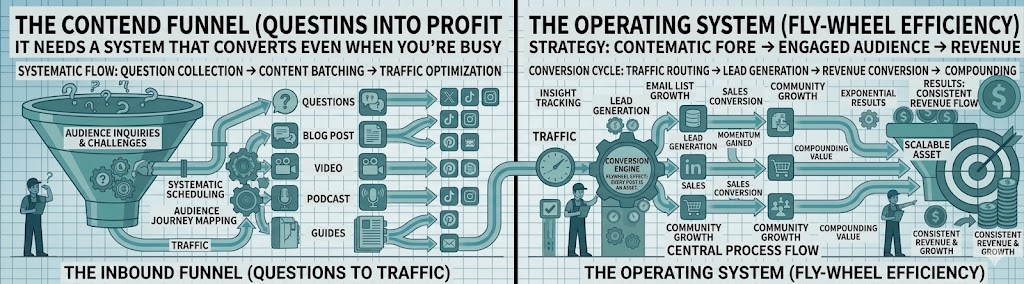
Shopify: From Questions to Traffic Machine
Shopify needed to attract and educate entrepreneurs at scale. Instead of posting randomly, they built a structured content ecosystem.
They identified high-intent customer questions, built structured content around those questions, and distributed across multiple formats and channels — blog articles, videos, podcasts, and educational guides.
The result: massive organic traffic growth, domination in search results for business-related queries, and a reported ~90% revenue increase in one year tied directly to their content strategy.
This wasn’t random content. It was systematic, question-driven content production.
HubSpot: The Inbound Content Engine
HubSpot built a full-funnel content ecosystem centred around SEO blog content, lead magnets, email nurturing, and multi-channel distribution. Not random posts — a machine. The result: companies using similar inbound systems saw up to 339% increases in leads and 350% growth in customers.
Content → Capture → Nurture → Convert. That’s not a strategy. That’s a system.
“Content isn’t king, it’s the kingdom.” — Lee Odden
Nuvemshop: Infrastructure Over Impulse
Nuvemshop used structured inbound marketing with content-driven acquisition, integrated CRM and automation, and consistent multi-channel distribution. The result: 900% growth in customer base in under 6 months.
This is what happens when content is tied into a system with infrastructure — not just publishing.
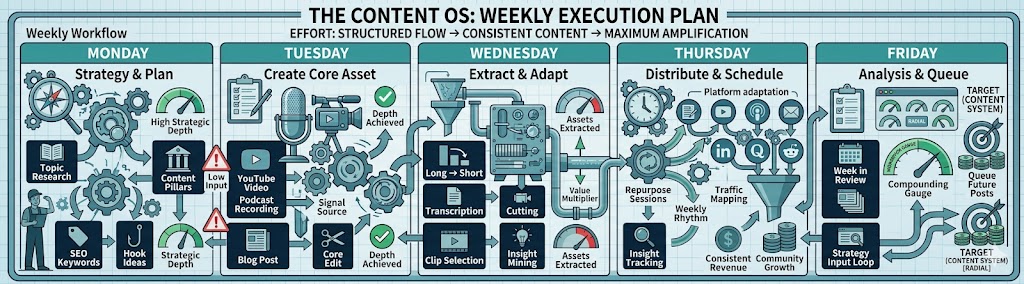
The Engine in Practice: The Weekly Content System
Here’s how a Content System actually runs — week by week, without burnout.
Monday: Strategy & Outline
You don’t just write. You plan. You pick your Persona, your Core Problem, and your Search Intent. You choose the Path (Actionable, Analytical, Aspirational, or Anthropological) and define the Approach (How-to, Framework, Story).
Result: A locked-in topic and a structure that guarantees depth before you write a single word.
Tuesday: Create the Core Asset
You record one YouTube video or write one comprehensive blog post. This is your ‘Signal Source.’ You focus entirely on creating the single best piece of content on this specific topic.
Result: High-value asset created.
Wednesday: Conversion & Extraction
You open your Repurposing Extraction Sheet and mine the core asset for gold: 3–5 key insights, 2–3 contrarian takes, the best hooks, and the clip-able moments for Shorts.
Result: A Repurposing Bank filled with raw material.
Thursday: Distribution Asset Creation
You don’t invent new ideas. You adapt extracted material to platform skins.
- A Contrarian Take becomes a LinkedIn post
- A Framework Step becomes a Pinterest Pin
- A Clip Moment becomes a YouTube Short
- A Key Insight becomes a Quora answer
Result: 10+ distinct pieces of content — without a single new brainstorming session.
Friday: Scheduling & Queueing
You build a library. You schedule your Blog and YouTube for launch. You stagger your distribution assets over the next 30 days using the 30-Day Distribution Model.
Result: Your marketing for the next month is done. You’ve bought back your time.
The Structure of Your System
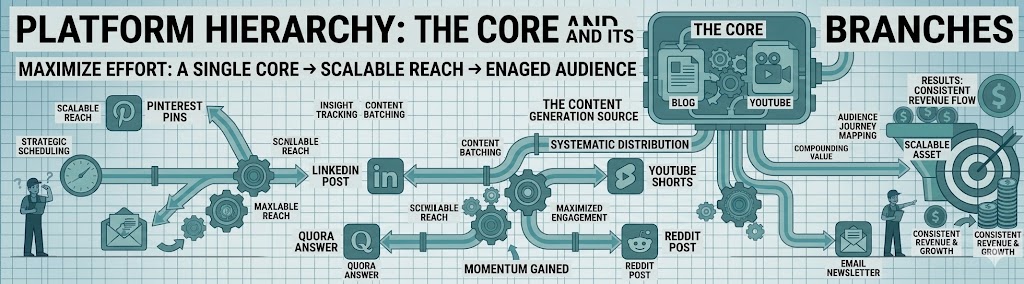
This isn’t about being everywhere. It’s about building a hierarchy where every platform has a job.
Primary Long-Form Platforms (The Roots)
- Blog: The evergreen search traffic asset. It captures intent, houses your frameworks, and builds topical authority.
- YouTube (Long-Form): The trust asset. It builds relationship, explains frameworks visually, and is the proof of depth.
Distribution Platforms (The Branches)
- Pinterest: Not social media — a visual search engine. Drives long-tail traffic back to your roots.
- LinkedIn: Authority and conversation. Test hooks and start discussions.
- YouTube Shorts: Hook viewers into your long-form content.
- Quora: Intent capture. Answer active questions from people already looking for solutions.
- Reddit: Discussion and language mining. Learn the exact pain points your audience uses.
- Email: The only platform you own. Turns attention into trust and traffic into leads.
“Content builds relationships. Relationships are built on trust. Trust drives revenue.” — Andrew Davis
Still Thinking Like a Poster? Read This.
The most common questions from business owners making this shift:
Posting content is a one-time action. A content system is a repeatable process that turns one idea into multiple assets and distributes them strategically over time.
Because volume without structure doesn’t compound. Without a system, every post starts from zero and disappears quickly.
It eliminates daily decision-making. Instead of asking ‘what do I post today?’, you follow a predefined workflow that tells you exactly what to do.
A system where you create one high-value piece of content — like a blog or video — and repurpose it into multiple smaller assets across platforms.
Because they rely on motivation and daily creativity instead of systems. This creates constant pressure to produce from scratch — and that pressure never stops.
Content that continues to generate traffic, leads, or engagement long after it’s published — especially through search and repurposing.
No. A system is about strategic presence, not everywhere presence. Focus on platforms that have a clear role in your pipeline.
Stop thinking like a content creator and start thinking like a system architect. Build processes, not just posts.
The Final Mental Model
Stop thinking of yourself as a Content Creator. That title implies a hamster wheel.
Start thinking of yourself as a System Architect.
An architect doesn’t lay every brick every day. The architect designs the building, assigns the workflows, and oversees the project. The building rises based on blueprints — not based on how motivated the architect feels on a Tuesday.
This is the promise of the CONTENT CREATION SYSTEM.
- A system you can run even with limited time
- A system that automates your creativity
- A system that removes thinking, planning, and guesswork
- A system built for business owners who need leverage, not more tasks
Stop asking: “How do I post more?”
Start asking: “How do I build a system that produces content for me?”
Posting more won’t fix your problem. But building a content system will eliminate it permanently.
You don’t need more motivation. You need a machine. Build the machine. Let the machine do the work.
Ready to Stop Posting and Start Systemizing?
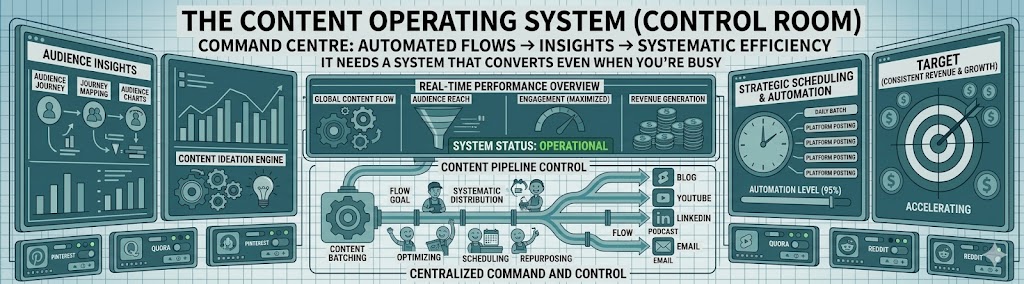
If you want content that compounds — not content that dies — I built THE AUDIENCE FIRST CONTENT CREATION SYSTEM.
It’s the exact system I use to turn one idea into a full week of marketing assets. It includes the Weekly Execution Workbook, the Repurposing Extraction Sheets, and the Platform Templates covered in this post.
This is the bridge from Chaos to Control.
Create content that works for you — not content that you have to work hard for.