Alistair Q Vermaak – Systems Architect

Why Your AI Content Sounds Like Everyone Else’s (And How to Fix It Today)

You hit “generate.”


The AI spits out 500 words.


You read it.

It’s… fine.


Polished. Professional. Perfectly boring.


It sounds like every other blog post, LinkedIn caption, and email you’ve ever skimmed past without remembering. You know it. Your audience knows it. And worse — Google knows it.

The uncomfortable truth:

AI isn’t the problem. Your prompts are. Most people treat AI like a magic content machine. They type a vague request, hit enter, and hope for gold. What they get instead is generic, forgettable fluff that sounds exactly like everyone else using the same tool.

In this post, you’re going to see exactly why your AI content sounds robotic — and how to fix it using a simple five-layer system that turns bland AI output into content that actually sounds like you.

The Scale of the Problem (The Numbers Are Startling)

Before we get into the fix, let’s get clear on just how crowded this space has become — because the data makes a compelling case for doing things differently.

74.2% of newly created web pages now contain AI-generated content.

Source: Ahrefs — What Percentage of New Content Is AI-Generated?

That’s not a trend anymore. It’s a flood. And when nearly three quarters of all new content on the internet is AI-generated, the bar for standing out has shifted completely.

Average is invisible now.

Human-written content ranks #1 approximately 80% of the time vs just 9% for pure AI content.

Source: Search Engine Land — Human Content vs AI Ranking Study

That statistic might look like an argument against AI. It isn’t. It’s an argument against lazy AI. The gap has almost nothing to do with the tool — it has everything to do with the input.

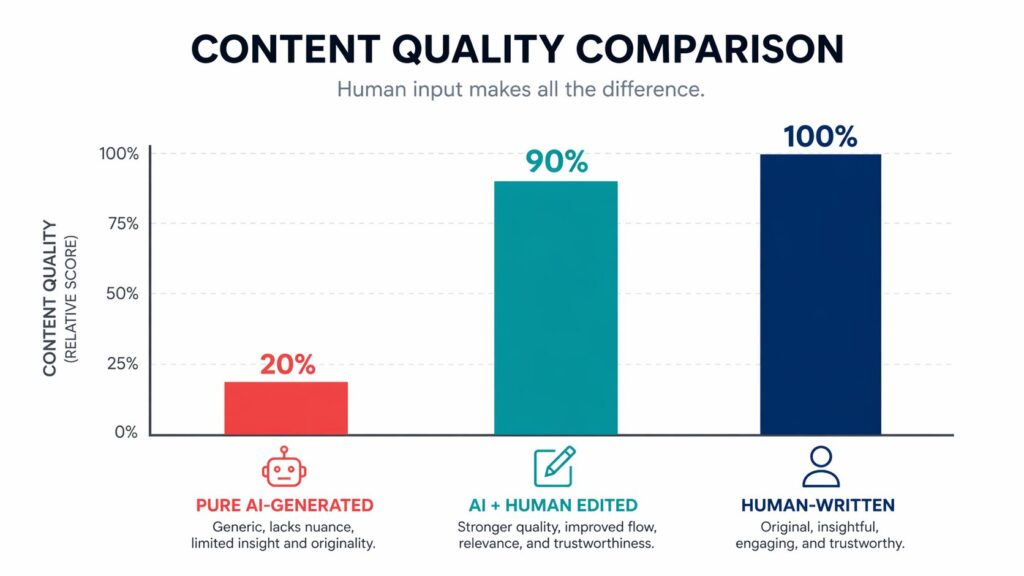
Pure AI content ranks 23% lower on average — but AI + human editing performs within 4% of human-written content.

Source: Digital Applied — 16-Month Google Ranking Study (4,200 articles)

Read that last one again. That tiny 4% gap closes almost entirely when you add context, structure, and human oversight. AI isn’t the ceiling — generic prompting is.

The Real Problem: AI Has No Context

AI tools like ChatGPT, Claude, Jasper, and Copy.ai are powerful — but they’re not mind readers.


When you give AI a prompt like “Write a blog post about content marketing,” it has absolutely no idea:


  • Who you are
  • Who you’re writing for
  • What makes your perspective unique
  • What tone you use
  • What outcomes you care about


So it defaults to the most statistically average response based on millions of generic articles it’s been trained on. That’s why your AI content sounds like everyone else’s.


It’s pulling from the same bland, middle-of-the-road language that floods the internet.

“Expert quotes only work when they feel real, relevant, and grounded in facts.”

— Joe Fares, SEO Strategist  |  Ultra SEO Solutions

The same principle applies to everything AI produces. Generic input produces generic output. Context is the ingredient that changes everything.

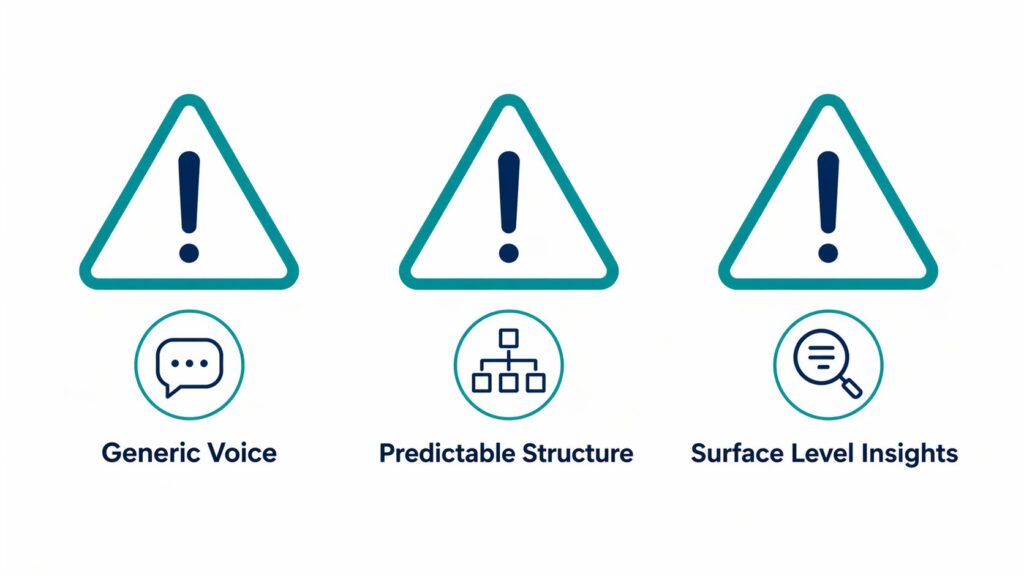
The Three AI Content Sins

Before we get to the fix, it helps to know exactly where the breakdown happens. Most AI content fails in one of three predictable ways.


Sin #1: Generic Voice


AI writes in “corporate neutral” — polite, safe, and utterly forgettable. No personality. No edge.


No you!


It sounds like a polished press release written by a committee of people who were afraid to say anything specific.


Sin #2: Predictable Structure


Every AI post follows the same formula: intro, three subheadings, conclusion with a call to action. It’s like reading the same article over and over with different words swapped in.


Audiences have pattern-matched this. They skim it. They tune it out.


Sin #3: Surface-Level Insights


AI rarely goes deep. It gives you the obvious take, the safe angle, the thing everyone already knows. No fresh perspective. No real value. No reason for your reader to keep reading or come back.


The result? Content that gets ignored — by your audience and by search engines.

Why This Matters More Than Ever

In 2024–2026, the internet became flooded with AI-generated content. Publishers, editors, and search engines got better at identifying it. And audiences started tuning it out.


Search Engines Are Filtering Generic AI Content


Google’s algorithms now prioritise helpful, original, people-first content. A well-documented case study of 487 Google search results found that fully AI-generated content — run with generic prompts and no editing — was in some cases deindexed entirely.


The same page, rewritten with better structure and context, was reindexed and ranking in the top 10 within hours. Same topic. Same keyword. Same tool. The only difference was input quality.

“LLMs prefer direct answers that immediately address user questions.”

— Macy Storm, SEO Content Consultant  |  SEO.com

Audiences Have AI Fatigue


People can spot robotic content quickly now. They scroll past it. They don’t engage. They don’t share it.


And more importantly, they don’t trust the brand behind it. Trust is the slow-burn currency of content marketing — and generic AI content burns through it fast.


Your Competitors Are Doing the Same Thing


If everyone in your space is using AI the same way, you all sound identical.


The only way to stand out is to engineer your AI output differently. This is actually good news — because most people won’t bother.

“Featured AI is here to help you share more of your expertise, not to replace it.”

— Brett Farmiloe, Founder  |  Featured.com

The Fix: Prompt Architecture

The secret to making AI sound like you isn’t editing after the fact. It’s engineering better inputs before you hit generate.


This is called Prompt Architecture — the system of structuring your AI prompts so the output is unique, on-brand, and usable from the start.

The core insight:

Most people use AI like a search engine. Prompt Architecture means using it like a system. You’re not asking for content — you’re engineering a result.

The 5-Layer Prompt System: A Full Breakdown

“The most AI-quotable content has three characteristics: definitive statements, specific data, and clear structure.”

— Shei Wah Tan, AI Content Strategy Expert  |  neo360.digital

That insight is essentially a description of what great prompting produces. Here’s how to engineer it systematically.


Layer 1: Identity — Tell AI Who It Is


Give the AI a role, a perspective, and a voice. Without this, it defaults to generic professional mode.

❌ Bad:

“Write a blog post about content systems”

✅ Good:

“You are a systems architect who helps business owners build repeatable content engines. You speak directly, use plain language, and focus on leverage over hustle.”

Layer 2: Audience — Tell AI Who It’s Writing For


Be specific. The more precisely you define the reader, the more relevant the output.

❌ Bad:

“Write for business owners”

✅ Good:

“You’re writing for solopreneurs with limited budgets who are overwhelmed by content advice and need a simple, actionable system they can implement today.”

Layer 3: Outcome — Tell AI What the Reader Should Do, Think, or Feel


If there’s no clear outcome, the content won’t drive action. Every piece of content should be pointing somewhere.

❌ Bad:

“Explain content repurposing”

✅ Good:

“After reading this, the reader should believe that one piece of content can become 10+ assets — and they should know exactly which platforms to repurpose to first.”

Layer 4: Structure — Tell AI How to Organise the Content


Don’t leave structure to chance. Define the flow explicitly and you’ll get output that actually builds to something.

✅ Good:

“Use this structure: Hook with a pain point → explain why the old way fails → introduce the system → break down 3 steps with examples → end with one action to take today.”

Layer 5: Style — Tell AI How to Write


This is often the most neglected layer, and the one that makes the biggest difference to how human the content feels.

✅ Good:

“Write in short sentences. Use contractions. No fluff. No corporate jargon. Sound like you’re explaining this to one person over coffee.”

Before and After: See the Difference in Action

Prompt Type

The Prompt

What You Get

Before (Generic)

“Write a blog post about AI content creation”

Polished. Generic. Forgettable. Sounds like 10,000 other posts.

After (Engineered)

“You are a systems architect writing for solopreneurs who hate how bland their AI output sounds. After reading, they should understand the 5-layer fix. Structure: Hook → problem → system → examples → one prompt template. Style: Direct, conversational, grade 4 clarity.”

On-brand. Specific. Actionable. Sounds like you.

What the Data Actually Says About AI Content

Three separate large-scale studies paint the same picture — and point to the same solution.


Study 1: 42,000 Blog Posts (SEMrush)


SEMrush analysed 42,000 blog posts across 20,000 keywords comparing AI-generated vs human-written content. Human content ranked #1 eighty percent of the time.


AI content ranked #1 only nine percent of the time. The implication isn’t that AI fails — it’s that generic AI doesn’t compete. Context-rich content does.


Study 2: 16-Month Experiment (4,200 Articles)


Tracking 4,200 articles across 140 domains over 16 months, Digital Applied found that pure AI content ranked 23% lower on average and earned 61% fewer backlinks than human-written content.


But AI content that was edited by a human performed within 4% of human content. The gap isn’t about the tool. It’s about depth, originality, and authority — all of which come from better inputs.


Study 3: Meta-Analysis (Ahrefs + SEMrush + Reboot)


A compiled meta-analysis drawing on data from Ahrefs (600,000 pages), SEMrush (20,000 URLs), and a 4,200-article longitudinal study found that 86.5% of top-ranking pages use some form of AI assistance — but pure AI-only content still ranks 23% lower on average.


The winners aren’t AI-only or human-only. They’re structured, high-context, hybrid content systems.
Content Type

Typical Performance

Key Factor

Generic AI only

Ranks ~23% lower | 61% fewer backlinks

No context, no depth

Generic human only

Inconsistent | often outpaced

No leverage, high time cost

AI + human editing

Within 4% of pure human content

Context + efficiency

Structured hybrid system

Consistently competitive

All 5 layers engaged

The Plug-and-Play Prompt Template

Here’s a template you can copy, customise, and use today. This is the 5-layer system in fill-in-the-blank format.

YOUR PROMPT TEMPLATE:

“You are [your role/identity]. You help [your audience] with [their core problem]. You’re writing for [specific audience segment] who [their current struggle]. After reading this, they should [believe/understand/do X].  Structure: [Hook format] → [problem explanation] → [solution introduction] → [breakdown with examples] → [one action to take today].  Style: [tone descriptors]. Write in [sentence style]. Use [language preferences]. Avoid [things to avoid].”

Filled-In Example:


“You are a systems architect who helps business owners build content engines. You help solopreneurs who are overwhelmed by content advice and need simple, repeatable systems. You’re writing for DIY builders who use AI but hate how generic their output sounds. After reading this, they should understand why their AI content is bland and know exactly how to fix it using a 5-layer prompt system.  Structure: Hook with frustration → explain the problem (AI has no context) → introduce the 5-layer system → break down each layer with examples → end with one template they can use today.  Style: Direct, conversational, no fluff, grade 4 clarity. Write in short sentences. Use contractions. Sound like you’re explaining this to one person over coffee. Avoid corporate jargon and generic transitions.”


How to Fix Your AI Content Today — 4 Steps

Step 1: Audit Your Last 5 AI-Generated Posts


Read them out loud. Do they sound like you — or do they sound like a polite robot? Look for these red flags:


  • Generic openers like “In today’s world…” or “It’s important to note…”
  • No personality, no unique perspective, no opinion
  • Surface-level insights that anyone could have written
  • Predictable structure: intro, three points, conclusion with a CTA


If you see these, your prompts need work. Not your tool.


Step 2: Build Your Master Prompt Template


Using the 5-layer system, write a master prompt that defines your identity, audience, outcome, structure, and style. Write it once. Save it. Reuse it every time you create content.


Step 3: Test and Compare


Run the same topic through your old prompt and your new engineered prompt. Put the outputs side by side. You’ll see the difference within seconds — and so will your audience.


Step 4: Inject Your Voice


Even with a great prompt, AI gives you the foundation — not the finished building. Add:


  • Personal stories or real examples from your own experience
  • Your specific frameworks, processes, or named systems
  • Contractions and casual language that sounds like you
  • Opinions, hot takes, or counterintuitive perspectives
  • Real data, case studies, or research citations


This is the final 10% that turns good AI output into content that builds genuine authority.

Frequently Asked Questions

Resources For Further Reading

What Happens When You Start Doing This

Once you start using engineered prompts, three things change — and they compound.


Your Content Sounds Like You


No more generic fluff. Your voice, your perspective, your frameworks. Content that could only have come from you — even when AI helped write it.


You Create Faster Without Sacrificing Quality


No more endless editing. AI gives you 80% usable output from the start. You spend your time refining and adding value — not rewriting from scratch.


You Stand Out


While everyone else sounds the same, your content cuts through the noise. This is how you build authority.


This is how you attract the right audience. This is how you turn content into a system that works.

The mic drop line:

AI didn’t break content. It exposed lazy inputs.  AI is the engine. Context is the steering wheel.

One Action to Take Right Now

Pick one piece of content you need to create this week. Build a 5-layer prompt using the template in this post. Run it through your AI tool. Compare it to what you would have gotten with a generic prompt.


You’ll see the difference immediately.


And if you want the full system — the one that shows you how to architect prompts for every content type, batch 30+ days of content, and scale without sounding repetitive — check out The Content Intelligence System.


It’s designed for people who want to use AI the right way: fast, effective, and on-brand.

Build systems. Scale with clarity.

Alistair Vermaak – Systems Architect

Leave a Comment

Your email address will not be published. Required fields are marked *

This site uses Akismet to reduce spam. Learn how your comment data is processed.