
Where to Find Ideas, What to Create, and Where to Publish It
Most business owners don’t really have a content problem anymore.
What they actually have is a systems problem — they just haven’t put a name to it yet.
You’ve probably seen it happen, or maybe you’ve experienced it yourself. Someone decides they’re finally going to take content seriously. They open a blank document, brainstorm a bunch of ideas, write a few posts, and start showing up consistently on social media.
For a week or two, everything feels great.
Then life gets busy.
The ideas dry up.
The momentum fades.
And before long, the content stops.
It’s usually not because they’re lazy, unmotivated, or incapable. It’s because the entire process was built on willpower instead of structure. They were relying on motivation to carry the workload.
The problem is that motivation comes and goes. Some days you have plenty of it. Most days you don’t.
Systems are different.
A good system keeps moving even when you don’t feel inspired. It removes the guesswork, reduces the friction, and makes content creation something you can repeat consistently instead of something you have to constantly force yourself to do.
Motivation runs out.
Systems don’t.

The mistake most people make with content is that they treat it as a series of creative moments.
They wait until they feel inspired, sit down to create something, publish it, and then start the whole process over again a few days later.
It’s reactive.
There’s no system behind it.
No place to capture ideas when they appear. No process for turning one idea into multiple pieces of content. No workflow that keeps things moving when business gets busy.
Every piece of content starts with the same question:
“What should I post today?”
That’s exhausting.
The businesses getting the best results from content aren’t necessarily creating more than everyone else. They’re just not starting from zero every time.
They’ve built systems for capturing ideas, organizing content, creating efficiently, and repurposing what already works.
Content becomes less about finding inspiration and more about following a process.
And that’s the difference.
One approach relies on creativity showing up on demand.
The other relies on a system that keeps producing results whether inspiration shows up or not.
📊 97% of businesses say they’ve generated positive results from content marketing — but only 52% of unsuccessful companies have a documented content strategy. (Orbit Media / Semrush)
The gap isn’t usually a content quality problem.
Most business owners already know enough to create valuable content. The real issue is that they don’t have a system that consistently turns their knowledge into published content.
Without a system, content becomes unpredictable. Some weeks you’re full of ideas. Other weeks you’re staring at a blank page wondering what to post.
This post will walk you through the framework that solves that problem.
At its core, every effective content system has three moving parts: where ideas come from, what you create with those ideas, and where that content gets distributed.
When those three pieces work together, content stops feeling like a constant struggle and starts behaving like an asset that compounds over time.
Think of this as the blueprint for a content engine—a simple, repeatable system that keeps producing content without forcing you to reinvent the wheel every week.
The framework looks like this:
• Inputs — where your content ideas come from
• Outputs — the content assets you create from those ideas
• Channels — the platforms and distribution systems that get your content in front of people
Master these three areas, connect them together, and you’ll never have to ask, “What should I post today?” again.
Let’s dive in.
Inputs: Where Your Content Ideas Should Come From
Stop Looking for Inspiration. Start Collecting Signals.
One of the biggest mistakes business owners make is treating inspiration as their content strategy.
The problem is that inspiration is unpredictable. Some days you have more ideas than you know what to do with. Other days you sit down to create and your mind goes completely blank.
That’s not a system. That’s luck.
If your content depends on feeling inspired, you’ll always be riding a rollercoaster of bursts of activity followed by long periods of silence.
The businesses that create content consistently don’t rely on inspiration. They rely on signals.
Signals are the questions your audience keeps asking. They’re the problems showing up in client calls. They’re the topics people are searching for online. They’re the recurring frustrations, misconceptions, and challenges that appear over and over again in your industry.
Instead of waiting for ideas to appear, you build a process for collecting them.
It’s the difference between hoping you’ll think of something to post and having a steady stream of content opportunities flowing into your system every week.
When you start paying attention to signals, content creation becomes much easier. You’re no longer guessing what your audience wants to hear. You’re responding to what they’re already telling you.
So where do these signals come from?
Let’s look at the most reliable sources.
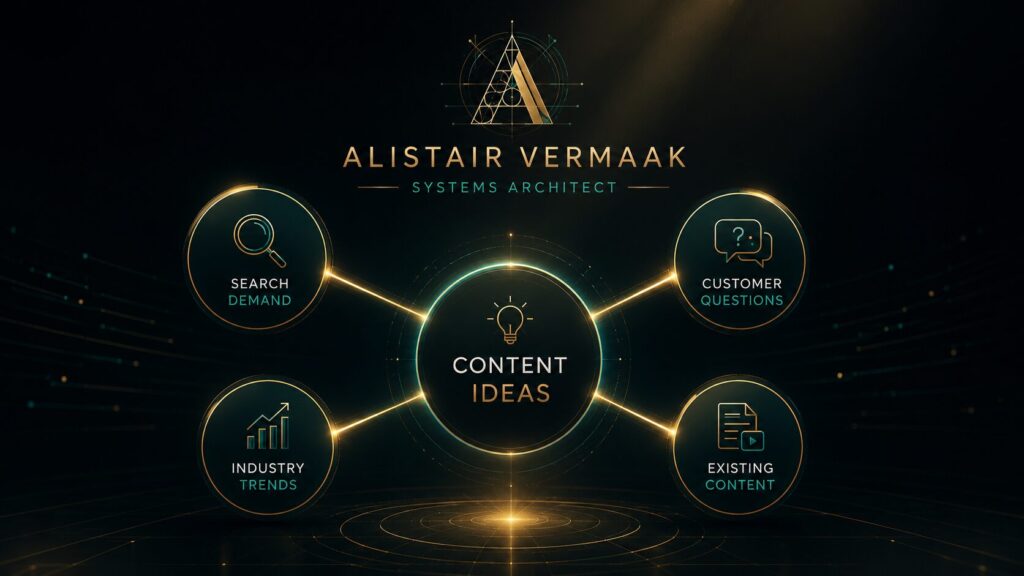
1. Customer Questions
Most businesses are sitting on an endless supply of content ideas without even realizing it.
Every day, customers are telling you exactly what they want help with. They ask questions during sales calls. They send DMs. They reply to emails. They leave comments on social media. The problem isn’t a lack of ideas. The problem is that most business owners don’t have a system for capturing them.
Think about it. Every question someone asks is a clue. It tells you what they’re struggling with, what they’re confused about, what they’re worried about, or what is stopping them from taking the next step.
Instead of treating those questions as one-off conversations, start treating them as content assets.
A great example of this is marketing expert Marcus Sheridan, who built a massive business by answering customer questions publicly. Rather than constantly trying to think of new content ideas, he simply documented the questions customers were already asking and turned the answers into articles, videos, and resources.
The process itself is surprisingly simple.
Create a place where every customer question gets captured. It could be a Notion database, a spreadsheet, a shared document, or even a simple notes app. The tool doesn’t matter. The habit does.
Over time you’ll start noticing patterns.
The same questions will appear again and again.
Those patterns become your content strategy.
Some of the best places to collect customer questions include:
• Sales calls — listen for recurring questions and objections
• Email conversations — pay attention to confusion points and concerns
• Direct messages — notice what people ask before they’re ready to buy
• Support requests — identify where customers get stuck after purchasing
• Social media comments — public questions often represent wider audience concerns
A useful rule to remember is this:
If one person asks a question, there are probably dozens more wondering the same thing.
When you answer that question publicly, your content starts working as both education and marketing at the same time.
2. Search Demand
Customer conversations tell you what your audience is saying directly.
Search data tells you what they’re looking for when you’re not in the room.
One of the easiest ways to find content ideas is to pay attention to what people are already searching for online.
Start typing a topic into Google and watch the autocomplete suggestions appear. Those suggestions aren’t random. They’re based on real searches being performed by real people. In many ways, it’s one of the most honest forms of market research available.
The same principle applies across platforms.
People search YouTube when they want a visual explanation. They turn to Reddit when they’re looking for real-world experiences and opinions. They use Quora when they’re trying to understand a problem in plain language.
Each platform gives you a different view into the questions your audience is already asking.
When you start seeing the same questions appear repeatedly, you’ve found something valuable. You no longer have to guess whether people care about a topic. The demand already exists.
Some of the best places to uncover search-driven content ideas include:
• Google Autocomplete and “People Also Ask” results
• YouTube search suggestions for tutorial and how-to topics
• Reddit communities where people discuss frustrations and challenges
• Quora questions that can be expanded into articles, videos, or newsletters
• AnswerThePublic for visual maps of related questions around a keyword
The goal isn’t to chase keywords.
The goal is to understand what your audience is trying to solve.
When you create content around questions people are actively searching for, you’re no longer creating content in a vacuum. You’re creating content that already has demand attached to it.
📊 Researching the audience and SEO are the top two factors leading to content marketing success — cited by approximately 50% of high-performing businesses. (Semrush)
3. Industry Trends and Competitor Content
A lot of business owners feel pressure to be the first person talking about a new trend.
In reality, you don’t need to be first.
You just need to be useful.
Whenever something changes in your industry—a new AI tool launches, a platform updates its algorithm, regulations shift, or customer behaviour starts changing—that’s a signal worth paying attention to.
Your audience doesn’t necessarily need breaking news.
What they need is context.
They want someone to explain what the change actually means, whether it matters, and what they should do about it.
That’s where your perspective becomes valuable.
The same applies to competitor content.
Keep an eye on what others in your space are publishing, but don’t approach it as a copying exercise. Instead, use it as research.
Ask yourself:
What questions are they leaving unanswered?
What practical details are they glossing over?
What assumptions are they making that a beginner might not understand?
What real-world implementation challenges are they ignoring?
The biggest opportunities often sit in those gaps.
Authority isn’t built by repeating what everyone else is saying. It’s built by adding clarity, context, and practical guidance where others stop short.
Some useful signals to monitor include:
• AI developments and emerging tools relevant to your audience
• Industry news and regulatory changes
• Competitor articles, videos, and newsletters
• Platform updates that affect visibility, traffic, or content performance
When you consistently interpret what’s happening in your industry through the lens of your audience, you become a trusted guide rather than just another commentator.
4. Your Existing Content
This is probably the most overlooked content source of all.
Most business owners are so focused on creating something new that they completely ignore the assets they’ve already built.
But your existing content is packed with signals.
Every blog post, video, email, podcast episode, or social media post has already generated data. Some pieces attracted traffic. Some sparked conversations. Some got shared repeatedly. Others quietly disappeared without much response.
That’s valuable information.
Your audience has already shown you what they care about.
The mistake is assuming that once a piece of content is published, its job is done.
In reality, your best-performing content is often the starting point for your next round of content creation.
A popular blog post can become a video.
A successful video can become an email series.
A high-performing email can become a social media campaign.
A topic that worked last year can be refreshed with new insights and examples.
Instead of constantly searching for new ideas, spend time analysing what’s already working.
Look for:
• Blog posts that consistently attract traffic
• Emails with high open and click-through rates
• Videos with strong watch time and engagement
• Social posts that generated shares, saves, or comments
• Content themes that appear repeatedly among your top performers
The goal isn’t to endlessly recycle content.
The goal is to identify proven topics and expand them into a larger content ecosystem.
When you start treating your existing content as a research asset rather than an archive, you’ll discover that many of your future ideas are already hiding inside your past successes.
Outputs: What Content You Should Actually Create
One Idea. Multiple Assets.
One of the biggest reasons content feels overwhelming is that most people treat every piece of content as a completely new project.
They come up with an idea, create a post, publish it, and then immediately start searching for the next idea.
The cycle repeats over and over.
The problem is that they’re squeezing all the value out of an idea in a single format and then abandoning it.
A better approach is to think of ideas as assets rather than individual posts.
A strong idea shouldn’t produce one piece of content.
It should produce an entire collection of content.
For example, a single customer question could become a detailed blog post, a YouTube video, several social media posts, an email newsletter, a downloadable resource, and eventually a sales asset that helps prospects understand your offer.
The core idea stays the same.
What changes is the format, the level of detail, and the purpose.
Each asset plays a different role within your business.
Some pieces attract attention.
Some build trust.
Some generate leads.
Some help move people closer to a buying decision.
When you start looking at content this way, you stop acting like a creator who constantly needs fresh ideas and start operating like a business owner building intellectual property.
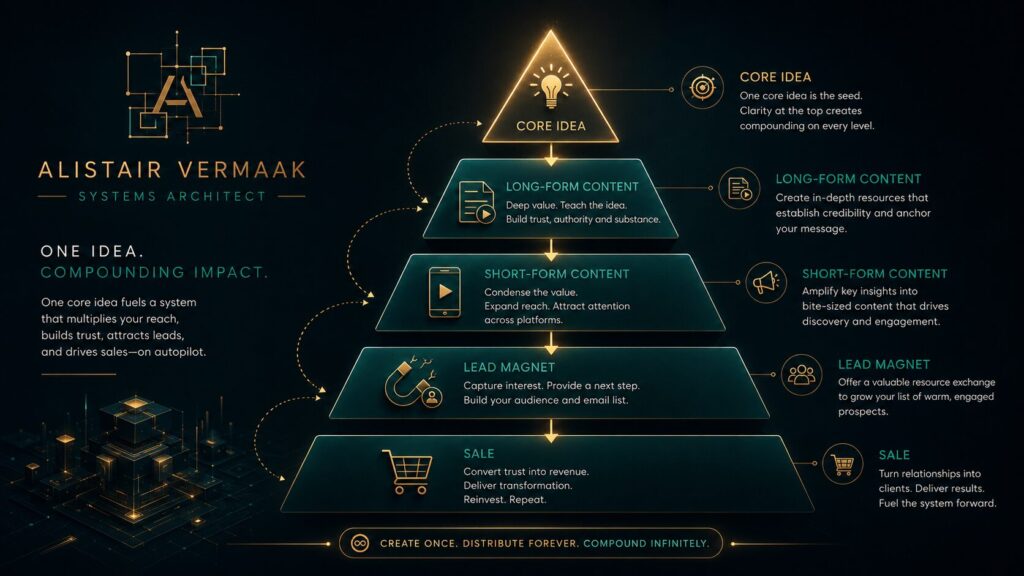
This is the foundation of what I call the Content Multiplication Model.
Instead of creating more ideas, you extract more value from the ideas you already have.
Here’s how the process works.
📊 Repurposing content increases results by 75% without a proportional increase in investment. Companies executing active repurposing strategies see double the engagement of those relying solely on original content. (Curata / HubSpot)
Long-Form Content
Every content system needs an anchor.
This is the piece where you stop scratching the surface and take a topic seriously.
It might be a detailed blog post, a YouTube video, a webinar, a workshop, or a podcast episode. The format itself doesn’t matter nearly as much as the depth.
Long-form content gives you room to explain, teach, demonstrate, and explore an idea properly.
That’s important because some things simply can’t be communicated in a 30-second video or a social media post.
This is where authority gets built.
It’s where people discover that you actually know what you’re talking about.
It’s also where search engines and AI search tools find the context they need to understand your expertise.
A short post might capture someone’s attention.
A long-form piece earns their trust.
Think about the difference between someone who watches a 15-second clip and someone who spends 20 minutes learning from you. By the end of that experience, they’ve invested time, gained insight, and developed a much stronger connection with your thinking.
That’s why long-form content should sit at the centre of your content system.
Everything else can be created from it.
Some common long-form content formats include:
• YouTube videos that dive deeply into a single problem or topic
• Blog posts that answer important questions and rank in search
• Live or recorded webinars and workshops
• Podcast episodes that explore ideas in greater detail
The goal isn’t simply to create more content.
The goal is to create one valuable asset that becomes the foundation for everything else.
The primary role of long-form content is simple:
Build authority, create trust, and establish a searchable body of expertise that continues working long after you hit publish.
This is where the relationship with your audience really begins.
📊 73% of B2B marketers say content marketing — particularly blogs and in-depth articles — is the most effective strategy for generating leads and sales. (Firework / CMI)
Short-Form Content
If long-form content is the foundation of your content system, short-form content is the distribution engine.
Its job isn’t to explain everything.
Its job is to get attention.
Short-form content is often the first interaction someone has with your brand. It’s the Reel that appears in their feed, the LinkedIn post they stop scrolling for, the Short that catches their attention, or the thread that makes them think, “That’s interesting.”
At this stage, you’re not trying to build a deep relationship.
You’re creating curiosity.
You’re giving people a reason to learn more.
One of the biggest mistakes creators make is treating short-form content as a completely separate content strategy. They spend hours trying to come up with new ideas for social media when those ideas already exist inside their long-form content.
Your blog posts, videos, webinars, podcasts, and workshops are full of material that can be repurposed.
A single long-form piece might contain:
• A key insight that becomes a LinkedIn post
• A powerful quote that becomes a graphic
• A practical tip that becomes a Reel
• A common mistake that becomes a YouTube Short
• A strong opinion that becomes a thread
• A compelling story that becomes a short video
The core idea stays the same.
You’re simply packaging it in different ways so more people can discover it.
That’s why I don’t think of short-form content as content creation.
I think of it as content distribution.
You’re taking one well-developed idea and creating multiple entry points into your world.
Common short-form formats include:
• Instagram and Facebook Reels
• YouTube Shorts
• TikTok videos
• LinkedIn posts
• X (Twitter) posts and threads
• Stories and behind-the-scenes content
The primary role of short-form content is simple:
Generate attention, expand your reach, and help new people discover your expertise.
It’s not where most trust is built.
It’s where awareness begins.
The goal isn’t to make every short-form post go viral.
The goal is to create enough points of contact that the right people eventually find their way to your deeper content, your email list, and ultimately your offers.
📊 Short-form video delivers the highest ROI of any content format — cited by 17% of all marketers as their top-performing channel. 45% of marketers say video outperforms all other formats. (HubSpot / Semrush)
Lead Generation Assets
This is where many content strategies break down.
Business owners spend time creating blog posts, recording videos, publishing social content, and building an audience. Then they sit back and hope that eventually some of those people decide to buy.
Unfortunately, that’s not usually how it works.
There needs to be a bridge between attention and sales.
That’s where lead generation assets come in.
A lead magnet gives people a simple next step. Instead of disappearing after consuming your content, they join your email list, download a resource, or enter your ecosystem where you can continue the conversation.
The best lead magnets aren’t massive ebooks that take weeks to create.
They’re practical resources that solve a specific problem quickly.
- A useful checklist.
- A proven template.
- A collection of AI prompts.
- A short implementation guide.
- A focused email course.
Something that delivers a quick win and demonstrates your expertise.
The goal isn’t to give away everything you know.
The goal is to create enough value that people think:
“If this free resource is this useful, I wonder what the paid version looks like.”
Some common lead generation assets include:
• Checklists that simplify a process
• Templates that save people time
• Prompt packs for AI tools and workflows
• Short tactical guides focused on a specific outcome
• Email courses that deliver value over several days
The primary role of a lead magnet is simple: Turn anonymous visitors into subscribers.
This is where attention becomes an audience.
Sales Assets
Once someone trusts you and joins your ecosystem, they need a clear path forward.
That’s where sales assets come in.
Think of sales assets as the final stage of your content system. They’re the pieces that help someone move from interested to committed.
A lot of content creators struggle with conversion, not because their content is bad, but because there’s no obvious next step.
The audience consumes the content.
They join the email list.
They receive a few emails.
And then… nothing.
No offer. No invitation. No clear direction.
The system simply stops.
Sales assets solve that problem by connecting trust to action.
They help people understand what you offer, why it matters, and how it can help them achieve a specific outcome.
Some common sales assets include:
• Case studies that showcase real-world results
• Landing pages focused on a single offer
• Offer pages that explain the value of your product or service
• Email sequences that educate, nurture, and guide people toward a purchase
The purpose isn’t to pressure people into buying.
The purpose is to make the next step obvious for people who are already interested.
The primary role of sales assets is simple:
Convert subscribers into customers.
This is where content starts generating revenue.
The Simple Rule
Every piece of content should have a purpose.
Every asset should move people to the next stage of the journey.
A simple content system looks like this:
Idea → Long-Form Content → Short-Form Content → Lead Magnet → Sale
That’s it.
One idea enters the system.
Multiple assets come out.
Attention becomes trust.
Trust becomes subscribers.
Subscribers become customers.
When you start thinking this way, content stops being a collection of random posts and starts becoming a business system.
And that’s the key distinction.
Content isn’t the goal.
Building a predictable engine for attracting, nurturing, and converting the right people is.
Every piece of content should have a job.
If you can’t explain what that job is, there’s a good chance you’re creating content for the sake of being busy rather than moving the business forward.
CASE STUDY: HubSpot — The Content Multiplication Machine
HubSpot built one of the most recognised content operations in B2B marketing on a deceptively simple model: answer every question a potential buyer might have, comprehensively, before they even get on a sales call. Their blog started as long-form educational content. That content got repurposed into social posts, email sequences, YouTube videos, and downloadable templates. Each format pulled from the same core idea bank. The result: over 8 million monthly blog visits, a lead magnet library with thousands of free tools, and a subscriber list that feeds directly into their product funnel. Their content doesn’t just build awareness — it runs their entire top-of-funnel acquisition. The key isn’t volume. It’s the system that turns one idea into ten touchpoints. Source: HubSpot Blog Statistics
Channels: Where You Should Publish Everything
The Hub-and-Spoke Model
One of the most important shifts a business owner can make is understanding the difference between rented platforms and owned assets.
Your website should be the centre of your content ecosystem.
Everything else is simply a distribution channel.
Think of your website as the hub and every social platform, email campaign, community, podcast appearance, or content channel as a spoke connected to it.
The purpose of those spokes isn’t to keep people trapped on the platform.
Their purpose is to introduce people to your brand and guide them back to assets you actually own.
- Your website.
- Your email list.
- Your products.
- Your resources.
- Your audience database.
That’s important because platforms are constantly changing.
Algorithms change. Organic reach fluctuates. Features come and go. Entire platforms rise and fall.
A strategy that works today may stop working six months from now, and there’s very little you can do about it because you don’t control the platform.
That’s why building your business entirely on social media is risky.
You may have followers, but if you can’t reach them without the platform’s permission, you don’t truly own that audience.
“You’re effectively borrowing access.”
The smartest businesses use social platforms for what they are: distribution channels.
They publish content on platforms where attention already exists, but they always have a mechanism that brings people back to assets they control.
That’s the purpose of the hub-and-spoke model.
The spokes create visibility. – The hub creates stability.
Social media helps people discover you.
Your website helps them stay connected to you.
Over time, this creates a far more resilient business because your audience, content, leads, and offers aren’t dependent on the decisions of a third-party platform.
The goal isn’t to build your business on social media.
The goal is to use social media to build assets that you own.

The hub-and-spoke model solves this problem by giving you a stable foundation.
Instead of building your business on platforms you don’t control, you build it around assets you own—your website, your email list, your content library, and your customer database.
Social media platforms then become what they were always meant to be: distribution channels.
Their job is to help people discover you and guide them back to your ecosystem, where you control the experience and the relationship.
That way, even if an algorithm changes tomorrow, your business doesn’t disappear with it.
Your Primary Channel
One of the biggest mistakes content creators make is trying to be everywhere at once.
They start a YouTube channel, launch a podcast, post on LinkedIn, publish on Instagram, experiment with TikTok, and then wonder why they’re exhausted three months later.
The answer is simple.
They’ve spread their attention too thin.
Instead, choose one primary channel.
Just one.
This is the platform where your best long-form content lives. The place where you go deep, build authority, and create your most valuable assets.
For most businesses, that’s usually a blog or YouTube.
Both have one major advantage over most social platforms: they compound.
A blog post can attract traffic years after it’s published.
A YouTube video can continue generating views, leads, and customers long after you’ve moved on to other topics.
Unlike a social media post that disappears from the feed within hours or days, long-form content can keep working in the background for months or even years.
The goal isn’t to pick the platform you personally prefer.
The goal is to choose the platform your audience already uses when they’re actively looking for solutions.
Then commit to showing up consistently.
Create depth.
Answer questions.
Solve problems.
Build a library of valuable content over time.
Everything else in your content system should support and amplify that primary channel.
Distribution Channels
Once you have a primary channel, distribution becomes much easier.
Unfortunately, this is the point where many content strategies fall apart.
Business owners often assume that every platform needs its own unique content strategy.
So they create one version of a message for LinkedIn, another for Instagram, another for TikTok, another for Facebook, and yet another for email.
Before long, they’re managing five different content calendars and spending more time creating content than running their business.
It’s not sustainable.
The better approach is much simpler:
- Create once.
- Repurpose strategically.
- Distribute everywhere.
Start with a strong core asset.
- A blog post.
- A YouTube video.
- A webinar.
- A podcast episode.
Then break that asset into smaller pieces that fit different platforms and audience behaviours.
The message stays the same.
The packaging changes.
- One key insight becomes a
- LinkedIn post.
- A practical tip becomes a Reel.
- A strong opinion becomes an X thread.
- A framework becomes an email.
- A customer story becomes a short video.
You’re not creating new ideas.
You’re creating new entry points.
Each piece of content introduces people to the same core idea and gently guides them back to your hub.
That’s how a content system scales.
Not by creating more content.
By extracting more value from the content you’ve already created.
📊 46% of marketers identify content repurposing as the single best-performing content marketing strategy — ahead of creating original content from scratch. (ReferralRock)
Now that you understand the hub-and-spoke model, the next question becomes:
What role does each channel actually play?
Because not all platforms are designed to do the same job.
- Some are better for discovery.
- Some are better for building trust.
- Some are better for nurturing relationships.
- And some are better for driving conversions.
The mistake many business owners make is expecting every platform to do everything. That’s rarely how it works.
A more effective approach is to understand the strength of each channel and use it accordingly.
YouTube
If your goal is to build authority and trust at scale, YouTube is hard to beat.
People don’t go to YouTube to mindlessly browse. They go there to learn, solve problems, and understand how things work.
That’s what makes it such a powerful platform for educators, consultants, creators, and service-based businesses.
The real advantage of YouTube is that content compounds.
A video you publish today can continue attracting viewers, subscribers, leads, and customers years from now through search and recommendations.
Think of YouTube as your digital library of expertise.
Every video becomes another asset working for your business in the background.
Best use: Long-form educational content and authority building.
System role: Primary anchor content and trust-building platform.
Blog / Website
Your website is your home base.
It’s where your most valuable content lives, where search traffic lands, and where visitors can move deeper into your ecosystem.
Unlike social media posts that disappear from feeds within days, blog content can continue generating traffic for years.
A well-written article that solves a specific problem becomes a permanent business asset.
The goal isn’t simply to publish more blog posts.
The goal is to build a searchable knowledge base that answers the questions your audience is already asking.
Every article strengthens your authority, improves your visibility in search, and gives people another pathway into your business.
Best use: Search traffic, educational content, and long-term authority.
System role: Owned content hub and SEO asset.
Instagram is primarily a discovery platform.
It’s where people often encounter your brand for the first time.
Short-form videos, carousels, and visual content allow you to package ideas into quick, easy-to-consume formats that fit naturally into people’s daily scrolling habits.
The key is not trying to teach everything in one post.
Your job is to spark curiosity.
Give people enough value to stop scrolling and enough interest to want more.
Then direct them toward your deeper content.
Best use: Brand visibility, audience growth, and content distribution.
System role: Short-form discovery and awareness.
Despite all the predictions about its decline, Facebook still matters for many businesses.
Particularly if your audience is made up of established professionals, business owners, or people over 30.
Groups remain one of the strongest community-building tools available online, and short-form video content continues to receive significant reach.
Facebook works especially well when you focus on conversations rather than broadcasting.
Communities, discussions, and engagement tend to outperform purely promotional content.
Best use: Community building and audience engagement.
System role: Relationship building and content distribution.
TikTok
TikTok is one of the fastest audience-growth platforms available.
Its algorithm is exceptionally good at putting content in front of people who have never heard of you before.
That means you don’t need a large following to generate meaningful reach.
What works on TikTok is simple:
Strong hooks.
Clear ideas.
Fast delivery.
Educational content, quick lessons, practical insights, and strong opinions all perform well when presented clearly.
Best use: Rapid audience growth and new audience discovery.
System role: Top-of-funnel awareness and reach.
Most people think Pinterest is social media.
In reality, it’s much closer to a search engine.
Users go there looking for ideas, solutions, inspiration, and resources they can save for later.
That’s what makes Pinterest particularly valuable.
Content has a much longer shelf life than on most social platforms.
A pin you publish today can continue generating traffic months or even years into the future.
For bloggers, educators, coaches, and content-driven businesses, Pinterest can become a surprisingly powerful source of evergreen traffic.
Best use: Long-term traffic generation and content discovery.
System role: Evergreen search and referral traffic.
LinkedIn is where expertise tends to outperform entertainment.
If your audience includes business owners, decision-makers, consultants, professionals, or B2B buyers, LinkedIn deserves serious attention.
People come to LinkedIn expecting professional insights, industry observations, and practical business lessons.
This creates an environment where thoughtful content often performs better than highly polished marketing.
Personal experience, lessons learned, and informed opinions frequently generate stronger engagement than corporate messaging.
Best use: Professional authority and B2B visibility.
System role: Credibility building and relationship development.
Reddit operates differently from almost every other platform.
People don’t go there to be marketed to.
They go there to find honest answers and genuine discussions.
That’s why direct promotion usually fails.
The opportunity comes from contributing useful insights, answering questions, and participating in communities where your expertise is genuinely valuable.
Interestingly, Reddit discussions often rank highly in search results, giving helpful contributions a surprisingly long lifespan.
Best use: Problem-solving, community participation, and expertise sharing.
System role: Trust building and search visibility.
Quora
Quora is essentially a giant collection of questions.
Which makes it an excellent place to find out what people are struggling with and to position yourself as someone who can help.
A thoughtful answer can continue attracting views long after it’s published because Quora content often performs well in search engines.
The most successful contributors focus on providing complete, useful answers rather than trying to sell.
The trust comes first.
The opportunity follows.
Best use: Educational content and question-based search traffic.
System role: Long-tail discovery and authority building.
Email is different from every other channel in your content system.
You own it.
You don’t own your followers.
You don’t own your reach.
You don’t own the algorithm.
But you do own your email list.
That’s why email should sit at the centre of every content-driven business.
Every platform ultimately exists to help people discover you.
Email is where the relationship deepens.
It’s where trust compounds.
It’s where offers get made.
And it’s where conversions often happen.
The businesses that survive algorithm changes, platform updates, and shifting trends are usually the businesses that invested early in building an email list.
Social media helps you borrow attention.
Email helps you keep it.
Best use: Relationship building, nurturing, and sales.
System role: The bridge between audience and revenue.
📊 Email delivers an average ROI of $42 for every $1 spent — more than 40 times the ROI of social media for customer acquisition. 42% of marketers say email is their most effective channel, far ahead of social (16%) and paid search (16%). (Litmus / Designmodo)
One of the biggest lessons in email marketing is that fancy doesn’t always perform better.
In many cases, simple text-based emails outperform heavily designed newsletters because they feel more like a message from a person and less like a marketing campaign.
People subscribe to hear from you, not necessarily to admire your email design.
Your subject line will often have a bigger impact on performance than anything inside the email itself. If nobody opens the email, nothing else matters.
It’s also worth remembering that consistency beats volume.
Sending one genuinely useful email every week will usually produce better long-term results than flooding people’s inboxes with daily emails that add little value.
As your audience grows, segmentation becomes increasingly important. Not everyone on your list wants the same thing. The more relevant your content becomes to different groups of subscribers, the better your engagement and conversion rates tend to be.
The primary role of email is simple:
Build relationships, nurture trust, and create a direct path to conversion.
Unlike social media, email isn’t dependent on an algorithm deciding who gets to see your content. Every subscriber is an asset you own and can communicate with directly.
WhatsApp and Telegram
If email is your owned communication channel, WhatsApp and Telegram are your high-intimacy channels.
These platforms create a level of closeness that most social media networks simply can’t match.
When someone joins your WhatsApp Channel, Telegram Channel, or community group, they’re inviting your content into a space normally reserved for friends, family, colleagues, and personal conversations.
That makes these platforms incredibly powerful.
It also means expectations are higher.
People are far less tolerant of spam, excessive promotion, or low-value content when it appears alongside messages from people they know.
The businesses that perform well on WhatsApp and Telegram understand this. They focus on relevance, usefulness, and genuine interaction rather than constant broadcasting.
These platforms work particularly well for:
• Exclusive updates and announcements
• Behind-the-scenes content
• Early access to resources and offers
• Community discussions
• Direct audience feedback
• Quick insights and observations
The communication style is usually different from email as well.
- Shorter messages tend to perform better.
- More conversational.
- More immediate.
- More personal.
Think less “newsletter” and more “helpful message from someone you trust.”
For many creators, coaches, consultants, and community-driven businesses, WhatsApp and Telegram can become some of the strongest relationship-building channels in the entire ecosystem.
The primary role of these platforms is simple:
Strengthen community, deepen engagement, and maintain direct communication with your most engaged audience members.
They’re not usually your biggest discovery channels.
They’re where relationships become stronger after discovery has already happened.
CASE STUDY: Pat Flynn — Hub-and-Spoke in Practice
Pat Flynn of Smart Passive Income built his entire distribution system on a clear hub-and-spoke model. His podcast episodes (the hub) became blog posts, YouTube videos, email newsletters, and social posts. He never created separate content for each channel — everything originated from one core recording. His email list sits at over 300,000 subscribers and consistently drives higher revenue per subscriber than any of his social channels combined. When his social reach fluctuated with algorithm changes, his email list insulated his business. The platforms changed. His asset didn’t. Source: Smart Passive Income — About
Why Most Businesses Get Stuck Here
This is the point where a lot of content strategies start to fall apart.
Business owners know they need to be visible online, so they try to create content for every platform at once.
One message for LinkedIn.
A different message for Instagram.
Another version for Facebook.
Something separate for TikTok.
A newsletter for email.
A blog post for the website.
Before long, they’re managing multiple content streams, multiple workflows, and multiple publishing schedules.
It’s exhausting.
And for most solo operators and small teams, it’s simply not sustainable.
The bigger problem is that none of those efforts compound.
Every platform becomes a fresh start.
Every post requires a new idea.
Every week feels like beginning from zero again.
That’s not a content strategy.
That’s a content treadmill.
The businesses that consistently succeed with content tend to operate very differently.
Instead of creating new ideas for every channel, they build around a single core idea.
They develop that idea properly once.
Then they adapt it into different formats for different platforms.
The blog post becomes a video.
The video becomes short-form clips.
The clips become social posts.
The social posts drive people back to the article, video, lead magnet, or offer.
The message stays consistent.
The packaging changes.
Every piece of content works together rather than competing for time and attention.
That’s what creates leverage.
You’re not trying to create more content.
You’re trying to get more value from every idea.
The result is a system that’s easier to maintain, easier to scale, and far more effective over the long term.
Less content creation.
More content multiplication.
Less complexity.
More consistency.
Less effort per channel.
More reach per idea.
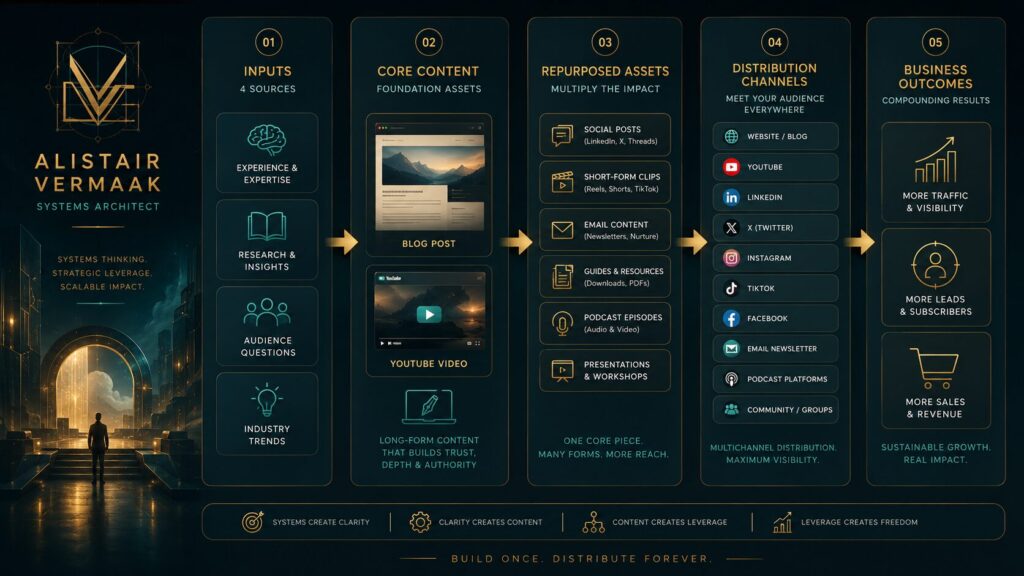
Visualising the Full System
Bringing It All Together
When all the pieces are connected, the system looks something like this:
Inputs → Customer questions, search demand, industry trends, and insights from your existing content flow into a central idea bank.
Core Content → Each strong idea becomes a long-form asset, such as a blog post, YouTube video, webinar, podcast episode, or workshop.
Content Multiplication → That core asset is then transformed into multiple supporting assets: short-form videos, social posts, email content, carousels, guides, lead magnets, and other distribution pieces.
Distribution → Those assets are published across the channels that make sense for your audience, with each piece adapted to fit the platform it’s being shared on.
Outcomes → Traffic flows back to your website, subscribers join your email list, leads enter your ecosystem, and customers move through your offers.
At first glance, it might look like a linear process.
But the most effective content systems don’t operate in a straight line.
They operate as a loop.
- Every new lead generates feedback.
- Every customer asks new questions.
- Every email reply reveals another challenge.
- Every sales conversation uncovers another objection.
- Every comment, message, and support request creates another signal.
And those signals feed directly back into your idea bank, giving you a continuous source of content topics that are rooted in real audience needs.
That’s what makes the system powerful.
You’re no longer guessing what to create next.
The audience helps shape the next piece of content.
Over time, the system becomes smarter, stronger, and more efficient because every interaction produces new information.
This is what content compounding actually looks like.
- Not publishing more content.
- Not chasing every new platform.
- Not working longer hours.
Building a feedback loop where every piece of content creates new opportunities, new insights, and new ideas for the next cycle.
The longer the system runs, the more valuable it becomes.
And eventually, content stops feeling like a marketing task and starts behaving like a business asset.
📊 62.8% of content marketers saw traffic growth between 2024 and 2025. The businesses seeing the most consistent growth share one trait: a documented, connected content system. (Siege Media / Wynter)
Final Thoughts
The businesses that consistently grow through content don’t have more creativity than everyone else.
They have better systems.
They’ve stopped relying on inspiration, motivation, and last-minute content ideas, and they’ve built a process that keeps producing results week after week.
At the heart of that process is a simple principle:
Don’t focus on creating more content.
Focus on creating a system that makes content easier to produce, easier to distribute, and more valuable over time.
That starts with a reliable way to collect ideas from real signals—customer questions, search demand, industry conversations, and the data hidden inside your existing content.
Those ideas are then developed into valuable long-form assets, multiplied into multiple formats, and distributed across channels that help new people discover your business.
Most importantly, those channels don’t become the destination.
They become pathways.
Every piece of content should ultimately lead people back to assets you own—your website, your email list, your products, and your ecosystem.
Because that’s where real business value is created.
When the system is working properly, everything connects.
- Ideas become content.
- Content becomes attention.
- Attention becomes subscribers.
- Subscribers become customers.
And customers generate new insights that feed the next cycle of content.
That’s the difference between content creation and a content system.
One depends on constantly coming up with new ideas.
The other becomes a self-reinforcing engine that gets stronger every time it runs.
Build that engine once, and you’ll spend far less time wondering what to create next—and far more time benefiting from the assets you’ve already built.
“If your content feels random, the problem probably isn’t your content. It’s the system behind it.”
Start by mapping your Inputs, Outputs, and Channels. Identify where the gaps are. Then build a workflow that connects them together.
Systems over hustle. Every time.
FAQ
How many platforms should I actually publish on?
Start with one primary channel and two or three distribution channels. Most solo operators and small teams overestimate how many platforms they can maintain with quality. Better to show up consistently on three channels than inconsistently on eight. Once your system is running smoothly — ideas coming in regularly, content being repurposed efficiently — you can expand.
How long does it take before the system produces results?
It depends on the channel and how well the content matches search demand. Blog posts and YouTube videos typically take three to six months before organic traffic starts compounding. Short-form social can produce results faster, but those results are less predictable and don’t compound the same way. Email results depend on list size and the quality of the lead magnet feeding it. Plan for a six-month runway before expecting consistent inbound traffic.
Do I need to be on TikTok if my audience is mostly professionals?
No. Platform selection should follow your audience, not trends. If your audience is professional services, B2B, or business operators, your time is better spent on LinkedIn, email, and YouTube. TikTok is exceptional for consumer-facing businesses and younger demographics. The question to ask is always: where does my specific audience go when they’re looking for the kind of help I provide?
What if I don’t have time to create long-form content?
Start smaller, but start structured. Even a 600-word blog post or a 5-minute YouTube video is a more durable asset than a feed full of daily social posts. The trap is believing short-form is easier because it’s shorter — in practice, it’s often harder because it has no context or depth to draw from. Long-form is the anchor. Short-form without it is just noise at regular intervals.
How do I build my email list if I’m starting from zero?
A lead magnet that’s specific and immediately useful is the most reliable starting point. Not a generic ‘sign up for updates’ — something specific enough that someone would genuinely want it in exchange for their email address. A checklist, a template, a short guide that solves one clear problem. Drive traffic to it through your short-form channels and your primary content. Every piece of content should have a clear next step that leads toward the list.
Should I use AI to create content?
Yes — as a tool in the system, not as a replacement for thinking. AI is useful for speeding up research, drafting first versions, repurposing content into different formats, and generating variation at scale. Where it falls down is original observation and genuine voice. The inputs — the signal collection, the customer questions, the real examples — those still have to come from human experience. Use AI to accelerate production. Don’t use it to replace the thinking that makes your content worth reading.
How is this different from just ‘posting consistently’?
Consistency without direction is just noise at regular intervals. Posting consistently on social media without a system behind it means you’re constantly creating from scratch, constantly guessing what to make, and constantly hoping something lands. This framework gives the consistency something to run on. Ideas come from a collection system. Content follows a multiplication model. Distribution follows a platform-specific logic. When all three are connected, consistency becomes sustainable — because you’re not making creative decisions every time you sit down to produce.
READY TO BUILD YOUR SYSTEM?
Start With the DIY Content Creation System
Everything you’ve just read—the idea collection process, the Content Multiplication Model, and the distribution framework—is exactly what the DIY Content Creation System was designed to help you implement.
It’s not another course full of theory.
It’s a practical operating system for solo operators, creators, and small business owners who want to stop wondering what to post and start running content as a repeatable business process.
Inside, you’ll find the tools, frameworks, and workflows that turn content creation from a constant challenge into a structured system.
That includes:
• A content batching framework that helps you create an entire month’s worth of content in a single focused session
• A repurposing workflow that shows you how to turn one core piece of content into multiple assets across different platforms
• Caption and copywriting frameworks that help you communicate clearly, attract attention, and connect with the right audience
• A 30-day content topic bank built around proven audience signals, search demand, and real-world content opportunities
• Step-by-step video walkthroughs that show exactly how the system works in practice
The goal isn’t to give you more templates to collect.
The goal is to give you a system you can actually run.
A system that helps you capture ideas consistently, create content efficiently, distribute it effectively, and build assets that continue working long after they’re published.
No guessing. No random posts. No relying on motivation to execute.
Just a practical content system designed to help you create consistently, attract the right audience, and turn content into a growth asset for your business.
Find out where your business
is leaking time and momentum.
20 questions across 4 dimensions. Scored instantly. You'll get an AI-generated breakdown written specifically to your numbers — with one concrete action to take this week.
5 minutes · Free · Instant results