
Most people don’t have a content problem anymore.
That problem died somewhere around the fifth AI writing tool.
Now the problem is coordination.
Everyone can produce. Hardly anyone can run the machine afterwards.
So what happens?
You end up with:
- drafts everywhere
- automations half-built
- twelve tools connected with hope and duct tape
- content going out with no real direction behind it
The output goes up. The clarity disappears.
I’ve watched a lot of people do this over the last year. They build what looks like a content engine from the outside, but internally it’s just noise moving faster.
AI didn’t break their business.
It exposed the parts that already had no structure.
That’s the real shift happening right now.
The people getting results with AI aren’t necessarily better creators. They’re better coordinators. Better operators. They understand which parts should stay human, which parts should become systems, and where automation actually belongs.
That’s the piece most people skip.
They automate before they architect.
Like pouring concrete before deciding where the walls go. Looks productive right until you have to live inside it.
So in this post, I want to show you the model I use.
Not theory. Not “future of AI” TED Talk material.
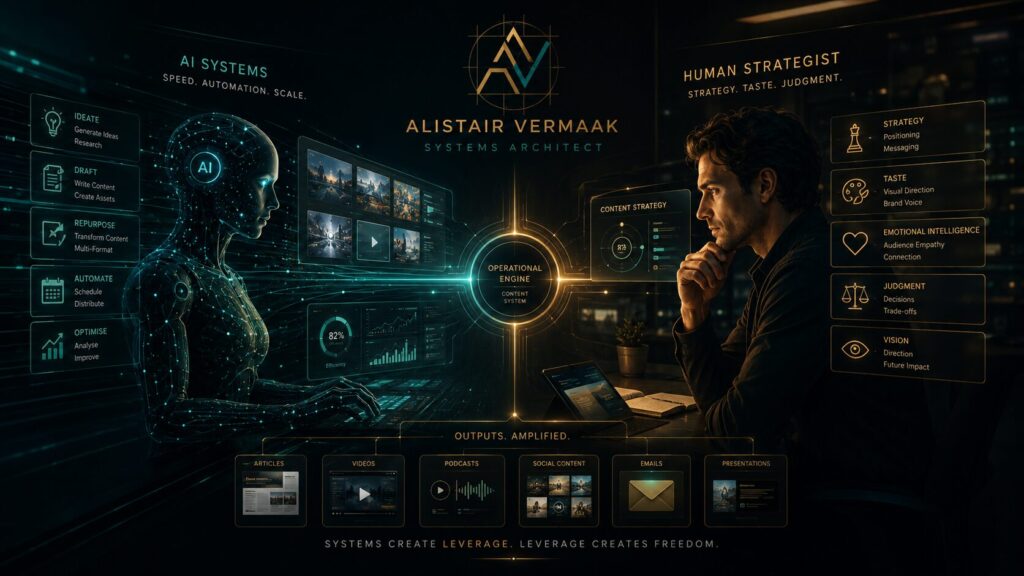
Just the practical split between:
- what the human should handle
- what AI should handle
- and how the two connect into a system that actually compounds instead of collapsing under its own weight.
Let’s get to it.

What We’re Actually Building
Before we go further, let’s clear something up.
A Human + AI Hybrid Model is not:
- ChatGPT writing your posts
- a prompt folder
- a Notion dashboard with thirty tabs
- a content machine running unattended like a haunted factory
That’s not a system. That’s delegation without structure. The real model is a division of labour.
Human Layer
AI Layer
- Direction
- Decision-making
- Context
- Taste
- Strategy
- Emotional Intelligence
- Drafting
- Automation
- Data processing
- Repurposing
- Speed
- Pattern Recognition
The human handles:
- direction
- judgment
- positioning
- emotional context
- knowing when something feels off
The AI handles:
- drafting
- restructuring
- speed
- formatting
- repetition
- turning one input into multiple outputs
Different jobs. Same system.
Most people mix the layers together. That’s why their workflow feels heavy all the time. They use AI for decisions and humans for repetitive labour. Completely backwards.
Here’s what that looks like in practice.
You spend two hours manually rewriting captions nobody needed to write manually in the first place… while AI decides your positioning because you never slowed down long enough to define it.
That’s like hiring forklifts and then carrying the bricks yourself.
The hybrid model fixes the split.
Human decides the direction.
AI increases the throughput.
The system handles the movement between stages.
That’s the architecture.
And once you see it properly, you stop asking:
“How do I make more content?”
Different question now.
The real question becomes:
“How do I build a pipeline that compounds?”
That’s where things start changing.
Why Most AI Content Feels Dead
You can usually smell AI writing in the first paragraph. Not because the grammar is bad. Because nothing feels observed.
Everything sounds technically correct but emotionally weightless. Like someone assembled the article from LinkedIn leftovers and startup podcasts.
The problem is rarely the AI itself. The problem is the missing human layer before the generation starts.
Most people give AI a topic instead of a perspective.
So instead of:
“Here’s something I’ve noticed after building this system for six months…”
They prompt:
“Write a blog post about AI productivity.”
That’s why everything comes back sounding like a customer support article wearing a blazer.
- No tension.
- No specificity.
- No lived experience.
- No real observations.
Just polished information floating in space.
Here’s the important part most people skip:
- AI is good at language patterns.
- It’s terrible at knowing which patterns matter.
That selection process – is human work.
That’s why two people can use the exact same AI tools and get completely different results.
One produces noise faster.
The other produces structured insight at scale.
Same technology. Different operator.
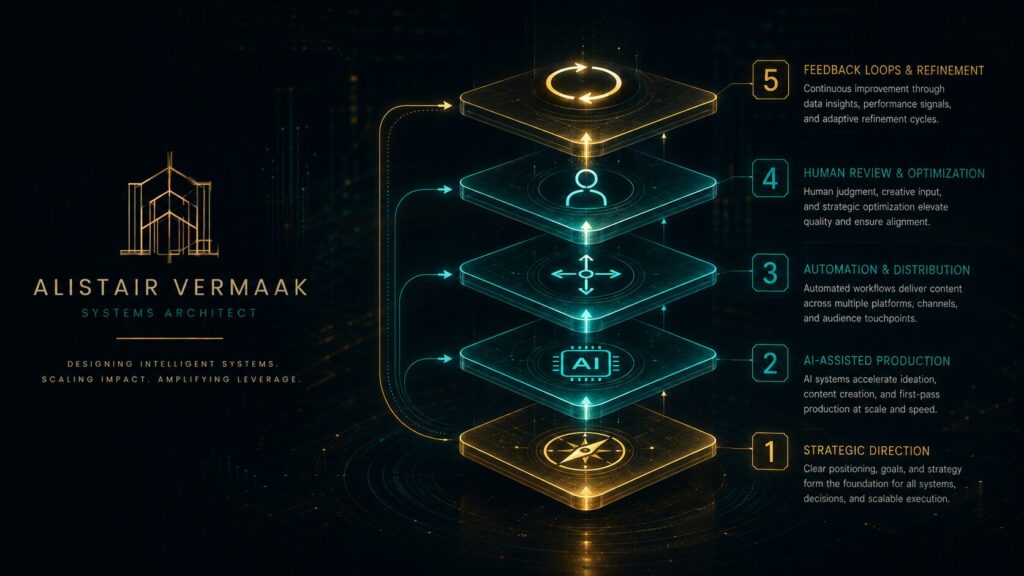
Layer 1 — Strategic Direction
This layer stays human.
Always.
You do not outsource positioning to a machine.
AI can help generate options. Fine.
But it should never decide:
- who you’re talking to
- what problem matters most
- what angle you’re taking
- what tradeoffs you believe in
- what your audience actually needs to hear
Most people skip this step because it doesn’t feel productive.
- No dashboard lights flashing.
- No fancy automations.
- No screenshots for Twitter.
Just thinking. Which is exactly why it’s the most important layer. If the direction is weak, the entire system downstream becomes expensive noise.
Here’s what that looks like in practice.
Before any content gets created, answer four things:
- Who is this specifically for?
- What are they stuck on right now?
- What do most people get wrong about this?
- What should happen after they consume this?
That’s the foundation. Everything else plugs into that. Skip it and you’re basically building a conveyor belt with random objects falling onto it.
The machine still runs. Nothing useful comes out the other side.
Layer 2 — AI-Assisted Production
This is where speed enters the system.
And honestly, this is where most people either become incredibly effective… or disappear into prompt goblin territory for six months.
AI should remove repetitive labour. Not replace thinking. Big difference.
Here’s what that looks like in practice.
You define:
- the angle
- the audience
- the structure
- the emotional direction
- the point you’re trying to make
Then AI helps:
- draft
- restructure
- expand
- compress
- repurpose
- generate variations
That’s the partnership.
The human architect + The AI construction crew.
If the architect disappears, the builders start putting doors on ceilings. Which explains a surprising amount of internet content right now. The mistake most people make is using AI too early in the process.
They haven’t clarified the idea yet. So the AI fills the vacuum with generic language. And because the draft looks polished, they mistake polish for clarity.
Dangerous combo. A shiny bad idea is still a bad idea.
The fix is simple.
- Human first.
- AI second.
- System third.
That order matters.
Layer 3 — Distribution & Automation
Content sitting in a Google Doc is not a content system. It’s a storage unit. This is where most people quietly fall apart.
They can create. Some of them create well. But distribution happens randomly.
A post goes out when they remember. An email gets skipped because the week got busy. Pinterest pins happen in one chaotic burst every three weeks like a panic-cleaning session before guests arrive.
No pipeline. Just effort. And effort is unreliable.
If the system needs you to manually remember every step, eventually something breaks. Usually on the exact week you needed momentum most.
Here’s what that looks like in practice.
One core idea enters the system.
From there:
- the blog gets published
- clips get extracted
- social posts get scheduled
- the newsletter gets drafted
- pins get created
- search-based content gets routed where it belongs
Same thinking. Multiple destinations. That’s the shift.
Stop treating content like single-use material. Treat it like raw material moving through a pipeline.
One input. Multiple outputs.
Most people are still rebuilding the fire every single day. The better model is building the furnace once and feeding it properly.
Different workload entirely.
And no, this doesn’t mean becoming “fully automated.”
That’s usually where people drive directly into a wall at high speed while holding a Zapier account.
You still need human review. You still need judgment. Automation handles movement.
Humans handle meaning.
That split matters.
Layer 4 — Human Review
This is the layer almost nobody talks about because it isn’t exciting.
- No dashboards.
- No viral screenshots.
- No “10x your workflow” nonsense.
Just observation.
But this is where the system actually improves.
AI can tell you:
- clicks
- impressions
- open rates
- watch time
Fine.
But numbers without interpretation are just expensive weather reports.
You still need someone looking at the system asking:
- Why did this work?
- Why did this fail?
- Why did this angle land harder?
- Why did this piece attract the right people?
- Why did that one attract people who will never buy anything?
That’s human work.
Here’s where things usually break.
People review metrics emotionally instead of operationally.
One post performs badly and suddenly they want to rebuild the whole system by Thursday afternoon.
Calm down.
A single weak post means almost nothing. You’re looking for patterns.
Repeated signals. Compounding behaviour over time.
That’s the game.
Not emotional reactions to Tuesday analytics.
Here’s what that looks like in practice.
Once a week:
- review what actually moved people
- review what created engagement with intent
- review what attracted the right audience
- review what quietly died on arrival
Then adjust the system slightly.
Not dramatically. Slightly.
Most people restart. Operators refine.
Huge difference.
Layer 5 — Refinement
This is the part that turns a workflow into a system.
Small improvements. Repeated consistently.
That’s it.
- No rebuilding.
- No platform hopping.
- No “starting fresh.”
Just refinement.
Every week the system gets:
- a little cleaner
- a little faster
- a little clearer
- a little more aligned with reality
That’s how growth actually works.
Not in giant leaps. In tiny operational corrections repeated for long enough.
Here’s what that looks like.
You notice:
- one prompt consistently produces weak openings
- one platform never converts properly
- one distribution path performs far better than expected
- one content structure keeps holding attention longer
So you adjust. Then the system runs again. That’s the loop.
Most people never stay with a system long enough to experience the compound effect because they’re addicted to rebuilding things instead of refining them.
Which is slightly ironic considering most productivity systems are just another means to feed your procrastination.
The Full Workflow
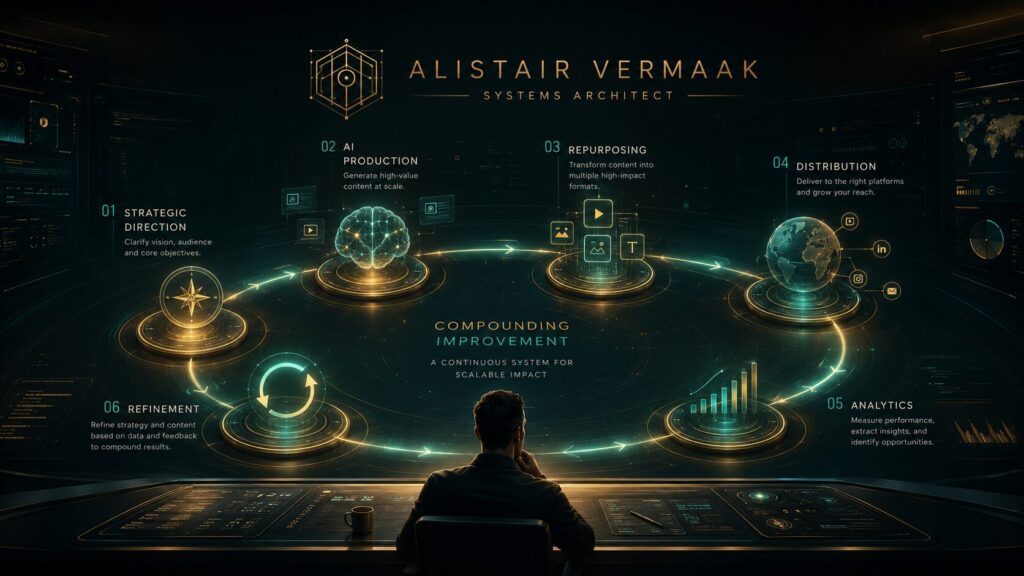
Here’s the complete flow.
No theory. No framework diagrams floating in white space.The actual sequence.
Step 1 — Define The Direction
Human.
Pick:
- the topic
- the audience
- the angle
- the problem underneath the visible problem
Not: “What do I feel like posting today?”
That’s not strategy. That’s creative roulette.
This part matters more than people think because every downstream layer inherits the quality of this decision.
Weak direction infects the entire system afterwards. Like bad foundations under expensive tiles.
Looks fine for a while. Then the cracks start showing.
Step 2 — Research The Real Questions
AI-assisted.
Use AI to identify:
- common questions
- fears
- search intent
- confusion points
- language patterns
But don’t blindly trust the research. AI is good at spotting patterns. It’s terrible at understanding emotional weight.
Different thing.
You still decide:
- which problems matter
- which angles are useful
- which conversations are worth entering
The machine helps organise the terrain. You still choose where to build.
Step 3 — Draft The Core Piece
AI-assisted.
This is where speed becomes useful.
You already know:
- the audience
- the angle
- the structure
- the point
Now AI helps produce the first draft faster. Not the final draft. The first draft.
That distinction matters because this is where people accidentally publish polished emptiness. The draft should save labour. Not replace perspective.
Step 4 — Human Refinement
This is where the content starts sounding alive again.
- You tighten the opening.
- Cut the soft language.
- Add the real example.
- Remove the generic transitions.
- Say the uncomfortable thing directly.
Now it sounds like someone who’s actually built the machine. Not someone summarising internet opinions into paragraph form.
This part usually takes less time than people think. Because the hard part wasn’t typing. The hard part was clarity.
Step 5 — Transform Into Distribution Assets
AI-assisted again.
Now the system reshapes the core piece into:
- emails
- posts
- clips
- pins
- threads
- search responses
Same thinking. Different packaging.
Most people try creating separately for every platform and burn themselves into the floor within three weeks.
Wrong model. One strong idea should travel.
Step 6 — Distribution
Automation handles movement.
- Scheduling.
- Routing.
- Publishing.
The system moves the assets where they need to go.
- Not perfectly.
- Not magically.
- But reliably.
And reliability beats intensity every single time.
Step 7 — Review
Human again.
Look at:
- quality of engagement
- audience fit
- conversion behaviour
- signal patterns
Ignore vanity metrics. A thousand views from the wrong people is useless.
Step 8 — Refine
Small corrections. Then the loop repeats. That’s the model.
Nothing glamorous about it. Which is probably why it works.
Why Human Skills Become More Valuable
This is the part most people get backwards.
AI does not make human skills less valuable. It makes shallow skills less valuable.
Big difference.
- Generic writing? Less valuable.
- Surface-level information? Less valuable.
- Repackaged advice? Almost worthless now.
But:
- judgment
- perspective
- clarity
- taste
- trust
- lived experience
Those become more important.
Because those are the filtering layers. AI can generate a thousand options. Humans decide which one actually matters.
That’s the bottleneck now. Not production – Selection.
I’ve watched people spend six hours generating variations of content that never should’ve existed in the first place.
Wrong problem.
The internet doesn’t need more content. It needs more authenticity.
And authenticity comes from:
- observation
- experience
- specificity
- clear thinking
Not from whatever comes to mind, or what AI can whip up.

The Businesses That Will Succeed
The winners won’t necessarily be:
- the best writers
- the loudest creators
- the people posting fifteen times a day like caffeinated meerkats
It’ll be the operators who build systems that keep working without emotional chaos attached to every decision.
That’s the real advantage.
Not speed – structure.
Most people are still operating manually while pretending they’re building a business.
Everything depends on:
- Mood.
- Energy.
- Motivation.
- Momentum.
That’s a fragile setup.
If motivation is carrying the entire machine, eventually the machine stops. The better model is operational clarity.
A system where:
- ideas enter cleanly
- content moves predictably
- distribution happens consistently
- refinement improves the engine over time
Build that properly and the whole thing starts compounding quietly in the background.
That’s the part people miss. The goal was never “create more.”
The goal was: Build once. Refine forever!
Where To Start
Don’t try to build the entire machine this weekend.
That’s how people end up with:
- fourteen automations
- three half-built dashboards
- a migraine
- and a Notion workspace that looks like an abandoned spaceship
Start smaller:
- One audience.
- One problem.
- One strong content path.
Build the first loop – Then refine it.
Then add layers afterwards.
Most people want the polished machine immediately. But systems are usually ugly at the beginning.
Fine.
Ugly systems that run beat beautiful systems that never leave the whiteboard. Start there.
Human direction first – AI second – Automation third.
That order matters.
Let’s get to it.