
The quiet cognitive shift I think every small business owner needs to confront
The Question Beneath the Question
This question gets asked constantly — in LinkedIn posts, in podcasts, in the comment sections of every AI article worth reading. Usually it goes: ‘Is AI taking our jobs?’ or ‘Can AI replace human creativity?’
Those are fine questions. But they’re not the one I keep coming back to.
The question that actually sits with me — the one I think will define where people land in the next decade — is quieter and harder to sit with:
“Is AI making us stop thinking for ourselves?”
This isn’t about what the models can do. They’re getting better every quarter — that’s not the debate. This is about what’s happening on our side of the screen. What happens to the internal machinery of thought when external processing becomes frictionless, instant, and always available?
I want to be clear upfront: I use AI every day. I build with it, I teach with it, I run my business with it. This is not a ‘return to pen and paper’ argument. But I’ve noticed something in my own workflow — and in the people I talk to — that I think is worth naming honestly.
AI is not replacing thinking. But it is quietly changing the conditions that require it. And that distinction matters more than most people realise.
The Shift Nobody Noticed
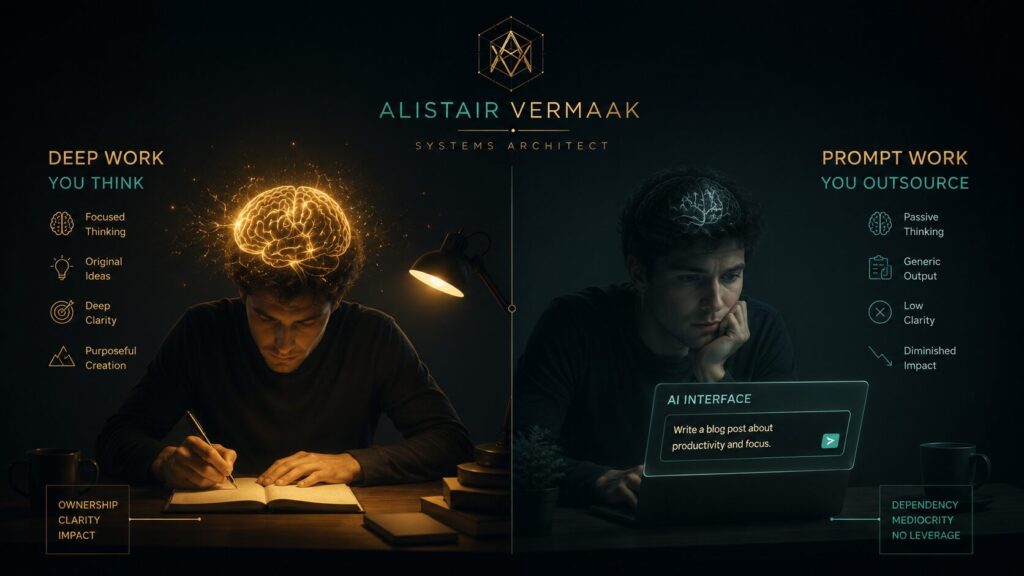
Before AI became part of our daily workflow, thinking was often unavoidable. To write, you had to work through your ideas. To generate an opinion, you had to form one. To summarise a document, you had to read, process, and interpret it yourself. The friction of producing an output was also the friction that shaped cognition.
That changed gradually — task by task, prompt by prompt.
Today, AI routinely handles drafting emails and proposals, generating ideas, summarising documents, supporting decisions, and accelerating research. None of this is inherently problematic. These capabilities save time, improve accessibility, and expand what individuals can accomplish.
The issue is not that AI can do these things. It’s that it does them so effortlessly that the internal processing that once preceded the output becomes optional.
And that’s the real shift.
When generating an idea, evaluating information, or working through uncertainty is no longer required, it’s increasingly easy to skip those steps altogether. Optional thinking, chosen often enough because it’s convenient, has a way of becoming habitual.
The concern isn’t that AI is replacing our ability to think. It’s that it’s changing how often we’re asked to use it.
A 2023 study from MIT’s Computer Science and Artificial Intelligence Laboratory found that frequent AI writing assistance reduced the diversity of written ideas and increased convergence toward similar outputs across users — a subtle but measurable reduction in cognitive originality over time. (Source: MIT CSAIL, 2023 — https://www.csail.mit.edu)
What Thinking Actually Is (And Why It Matters)
Before we can talk about what AI changes about thinking, we need to be more precise about what thinking actually is. Because it’s more layered than most people assume — and the layers matter.
Forming Ideas
This is not retrieving information. It’s synthesis — taking experience, observation, and knowledge and producing something that didn’t previously exist in that form. It’s generative. It requires holding loose inputs and pattern-matching across them over time.
Holding Ambiguity
Complex problems don’t have clean edges. Real thinking requires the capacity to stay in a state of not-knowing — to sit with a problem without collapsing it into a premature answer. Psychologist Mihaly Csikszentmihalyi identified this as a prerequisite for deep creative work. Most AI interactions do the opposite: they resolve ambiguity instantly.
Resolving Contradiction
Much of what we actually do as knowledge workers involves reconciling things that conflict — competing priorities, conflicting data, incompatible stakeholder needs. Working through contradiction is cognitively demanding. It also builds a form of mental endurance that shallow processing doesn’t.
Iterating Internally
Before ideas become content, they go through a hidden process of refinement. You think something, reject it, rephrase it, build on it, discard half of it, try again. This internal loop — invisible to anyone watching — is where most of the substantive thinking actually happens.
AI is extraordinarily good at simulating artificial thinking as tangible results in the form of text or images. It can produce text and images that look like the result of imaginative or creative thinking.
But it doesn’t — and can’t — go through the internal struggle that creates depth.
“The quality of thinking is not visible in the result. It’s embedded in the process that created it.”
— Alistair Vermaak
When we skip that process, we get results that look right but lack the invisible structure of real thought. And over time, we also lose the capacity to produce that structure ourselves.
The Drift Ladder: The Invisible Outsourcing of Thought
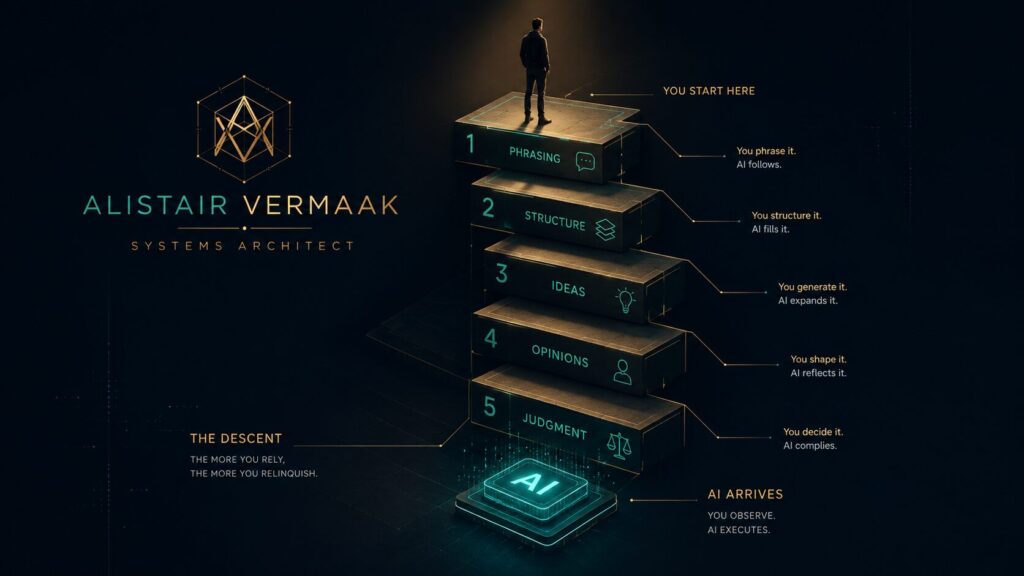
Nobody decides in a single moment to stop thinking for themselves. It doesn’t happen that way. It happens in increments — in thousands of small, individually reasonable decisions to let the tool handle it.
The progression I’ve seen — in my own work and in online conversations I’ve seen from other people — looks like this:
- You ask AI to help with phrasing — a word choice, a sentence that’s not landing.
- Then structure — how to organise a document, a proposal, a presentation.
- Then ideas — you have a topic but you’re stuck, so you ask for angles.
- Then opinions — you’re not sure what to think, so you ask AI for a perspective.
- Then judgment — you’re making a decision and you outsource the evaluation framework entirely.
At step one, you’re using a tool. At step five, you’re not thinking — you’re editing machine-generated cognition.
Each step is defensible in isolation. Each makes sense in context. The problem is that they compound. Each permitted outsource makes the next one slightly more natural — and the internal processing slightly more unfamiliar.
“Outsourcing doesn’t happen in one decision. It happens in thousands of small permissions.”
This has a direct parallel in physical fitness. No single skipped workout causes muscle loss. But consistent inactivity over months produces real, measurable atrophy — and the person who avoided the gym often doesn’t notice until they need the strength and find it lacking.
Cal Newport has observed that our tools don’t just perform tasks — they reshape the cognitive habits we develop around those tasks. Writing by hand builds different neural patterns than typing; outsourcing planning to an AI builds different — or erodes existing — mental models around judgment. (Source: Cal Newport, ‘Deep Work’, 2016 — https://www.calnewport.com/books/deep-work/)
The Cost of Convenience
What We Gain
- Speed — completing in minutes what previously took hours
- Clarity — translating complex material into accessible language
- Volume — producing more content, faster, across more channels
- Accessibility — enabling people to produce professional outputs regardless of prior writing skill
What We Risk Losing
- Cognitive endurance — the capacity to think deeply for extended periods without external support
- Original thought formation — the ability to generate ideas from the inside out, not the outside in
- Intellectual discomfort tolerance — the willingness to sit with unsolved problems long enough for real insight to form
- Epistemic ownership — the sense that your opinions and judgments are actually yours
There’s growing evidence that cognitive skills, like physical skills, require active use to maintain.
A 2022 study published in Computers in Human Behavior found that heavy reliance on GPS navigation measurably reduced spatial reasoning capacity in participants over time — not because GPS is bad, but because the cognitive work of wayfinding was consistently avoided. (Source: Computers in Human Behavior, 2022 — https://www.sciencedirect.com/journal/computers-in-human-behavior)
The same principle applies to AI and cognitive processing. If the tool consistently performs the thinking task, you consistently avoid the cognitive work — and avoidance, repeated at scale, produces atrophy.
“Thinking requires resistance. AI removes it.”
This isn’t a moral failing. It’s simply how human cognition responds to environmental conditions.
We’re wired to optimise for efficiency. When the environment removes friction, we use less effort — not because we’re lazy, but because we’re adaptive. The problem is that some of that friction was training load.

The Identity Change
Here’s the part of this conversation that rarely gets discussed: it’s not just about what we produce. It’s about who we become.
For most of human history, the identity of a knowledge worker, creator, or strategist was rooted in the capacity to think — to originate, synthesise, and judge. The professional self-concept was anchored in internal capability.
A new identity is emerging, and I’ve felt it in myself:
- Prompt engineer of cognition — skilled at asking the right questions of the machine
- Curator of answers — selecting from AI-generated options rather than generating options internally
- Editor of machine-generated thought — the primary cognitive role becomes assessment and refinement, not origination
None of these are without value. Curation, editing, and prompt engineering are real skills. But they represent a fundamental shift in where cognitive authority sits.
When you stop being the origin of your own ideas — when your default mode is to seek external generation before internal generation — something shifts in how you relate to your own thinking. The internal voice gets quieter. Confidence in your own unassisted judgment erodes.
OpenAI CEO Sam Altman has acknowledged the dual nature of this shift, noting that while AI dramatically amplifies human output, there’s a real question about whether it simultaneously diminishes the internal processes that made that output worth amplifying. (Source: Sam Altman, Lex Fridman Podcast, 2023 — https://lexfridman.com/sam-altman/)
Anthropic CEO Dario Amodei has similarly noted that the most important questions about AI are not technical but behavioural — how people choose to engage with these tools will shape cognitive culture more than any capability threshold the models cross. (Source: Dario Amodei, Machines of Loving Grace, 2024 — https://darioamodei.com/machines-of-loving-grace)
The Real Risk Is Not Dependence — It's Atrophy
When people talk about AI risk and human cognition, the conversation usually focuses on dependence: using AI too often, in the wrong situations, or for the wrong reasons. In other words, it’s framed as a behavioural problem.
I think the deeper risk is something else entirely.
It’s not dependence. It’s atrophy.
Cognitive atrophy is the gradual weakening of our internal processing capacities through disuse. It doesn’t arrive dramatically. It feels like convenience. The brain’s ability to sustain focused, generative thought isn’t fixed; it’s use-dependent. Research from Stanford’s Social Neuroscience Lab suggests that the brain networks associated with self-generated thought become less active when we spend more time consuming and less time creating. Similarly, Dr. Adam Gazzaley and Larry Rosen’s work in The Distracted Mind argues that habitual cognitive offloading—relying on external systems for tasks our brains once handled—can diminish working memory and executive function over time.
Applied to AI, the implication is straightforward. If you consistently outsource the generative, synthesising, and evaluative parts of your work to a model, you’re consistently bypassing the mental processes that perform those functions. Over months and years, that isn’t neutral.
The productivity gains are real, and operators who learn to work effectively with these tools will have an advantage. But the question isn’t simply whether you use AI. It’s how you use it.
Are you using it to challenge your thinking, refine your ideas, and extend your capabilities? Or are you using it to avoid the very cognitive work that keeps those capabilities sharp?
The distinction matters. Every interaction with AI is doing more than producing an output. It’s training you—or untraining you. The real question is whether the person emerging from that process is becoming more capable or quietly giving ground.
(Source: Stanford Social Neuroscience Lab — https://ssnl.stanford.edu)
Dr. Adam Gazzaley and Larry Rosen’s research, (Source: MIT Press — https://mitpress.mit.edu/9780262534437/the-distracted-mind/)

Reclaiming Thinking in an AI-Enabled World
I think small business users who develop genuine AI fluency will outperform those who don’t. The goal is not to eliminate AI from your workflow — it’s to be conscious about what you’re using it for and what you’re protecting.
Here’s what I actually do — and what I’ve seen work for others:
1. Delay the Prompt
Before opening any AI tool to help with a task, I give myself a fixed window — usually ten minutes — to work on it internally first. The initial thinking doesn’t need to be good. It needs to happen. The act of attempting the problem yourself before outsourcing it is what maintains the neural pathway.
2. Form Initial Thoughts Before Seeking Validation
When I use AI to evaluate ideas or decisions, I write down my own assessment first. Then I compare. This turns AI into a thinking partner rather than a thinking replacement — and it preserves epistemic ownership of the conclusion.
3. Identify What You Will Not Outsource
There are categories of thinking that define your professional identity and intellectual edge. Strategic judgment. Creative voice. Ethical reasoning. I’ve named those categories explicitly and I protect them. I use AI generously for everything else.
4. Rebuild Cognitive Endurance Intentionally
I schedule regular periods of unassisted thinking: writing without AI, planning without prompts, reading without summarisation tools. This isn’t nostalgia for inefficiency. It’s maintenance of a capacity that compounds over time.
5. Thinking First, AI Second
This is the non-negotiable. Thinking comes first. AI augments the output of that thinking. When this order reverses — when AI generates and I refine — the quality of the work might look similar, but the trajectory of the thinker is different.
“The goal is not to use AI less. The goal is to use AI in a way that leaves you more capable than before you used it.”
— Alistair Vermaak
Case Study: When AI Changed Thinking
The Consultant Who Stopped Forming Opinions
A senior strategy consultant at a mid-market advisory firm began using AI for client deliverables in early 2023. Within eighteen months, she noticed she had stopped forming initial hypotheses before client calls — she would prompt an AI model for likely findings instead. When a key client asked for her personal view on an acquisition decision, she found herself unable to form one without first consulting the tool. She describes the experience as ‘discovering I had outsourced the part of my job that made my advice worth paying for.’ She now uses a 24-hour rule: no AI involvement in strategic recommendations until she has written her own view in full.
(Reported in Harvard Business Review, ‘The New Skill Gap’, 2024 — https://hbr.org)
The Final Question
I haven’t argued that AI is dangerous. I’ve argued that it’s consequential — and that the consequences extend beyond productivity and output into the quieter territory of how we think, who we are as thinkers, and what we’ll be capable of in five or ten years.
The capabilities of AI will keep improving. The tools will get more integrated, more seamless, more embedded in every cognitive task. That’s not changing.
But none of it changes the underlying question. It just makes it more urgent.
“Are you using AI to extend your thinking… or replace it?”
The answer won’t be visible in any single piece of work. It’ll be visible in the trajectory — in whether the thinking you’re capable of in five years is deeper, sharper, and more distinctly yours than the thinking you’re capable of today.
That’s the real metric. Not output volume. Not efficiency gains. The quality of the mind doing the work — and whether that mind is growing or quietly giving ground.
The difference defines the next decade of solo operators, creators, and knowledge workers. And you get to choose which side of it you’re on.
You don't notice cognitive drift while it's happening.
That’s why I built the Solo Operator Systems Score.
In five minutes, you’ll discover whether AI is amplifying your thinking or quietly replacing parts of it—and exactly where to strengthen your operating system before the gap widens.
Five minutes. Honest results. No fluff.
Find out where to start — before the drift gets further.
I Created Videos On This Very Topic:
About Alistair Vermaak
I’m a Systems Architect and solo operator documenting what it actually looks like to build a business with AI — not the hype, the reality. I write about content systems, AI workflows, and the cognitive side of operating in a world where the tools are getting smarter faster than most people are adapting.
If this resonated, you’re in the right place.
Frequently Asked Questions
These are the questions I see most often from people thinking through this for the first time.
Is AI making people less intelligent?
Not in a blanket sense — but it may be reducing the exercise of certain cognitive capacities in regular users. Intelligence isn’t a fixed asset; it’s shaped by the mental work we consistently do. If AI routinely handles the generative and evaluative tasks that build cognitive depth, those capacities may weaken through disuse. This isn’t about IQ — it’s about the quality and frequency of the cognitive work you actually engage in.
Does using AI for writing reduce creativity?
It can, depending on how you use it. Research from MIT and other institutions suggests that frequent AI writing assistance tends to narrow the diversity of ideas over time — outputs begin converging toward AI-typical patterns. But users who maintain the habit of generating their own ideas before using AI to refine or expand them tend not to show this narrowing. The key variable is whether AI enters the process before or after initial human generation.
How do I know if I am over-relying on AI?
A useful test: attempt a task in your core area of expertise without any AI assistance. Write the strategy doc alone. Draft the proposal from scratch. Form the recommendation before consulting the tool. If the experience feels unusually difficult, unfamiliar, or anxiety-producing — more so than it would have two years ago — that’s a signal worth paying attention to.
What are the long-term effects of AI on human thinking?
The research is still emerging, but the early signals point to a split outcome. Those who use AI as an amplifier of their existing thinking — maintaining the habit of internal processing and using AI to extend or refine it — are likely to see genuine cognitive enhancement. Those who use AI as a replacement for thinking risk gradual atrophy of the capacities they stop exercising. The long-term differential between these two groups could be significant.
Is it bad to use AI for decision-making?
Not inherently. Using AI to gather information, model scenarios, or surface considerations you might have missed is legitimate and valuable. The concern arises when AI replaces the human judgment step — when the AI recommendation becomes the decision rather than an input to it. Keeping judgment explicitly human, even when AI is used heavily for preparation, is both practically wise and cognitively protective.
Can AI improve critical thinking skills?
It can, if used deliberately for that purpose. Prompting AI to argue against your position, to identify weaknesses in your reasoning, or to present the strongest case for the opposing view are all practices that can actively sharpen critical thinking. The tool itself is neutral — it amplifies whatever cognitive practice you bring to it.