Alistair Q Vermaak | I Build Scalable Systems

Have you ever had one of these conversations?

“Do we have that document somewhere?”

“I know we wrote this down…”

“Didn’t we already solve this problem?”

“Who has the latest version?”

“Hang on… let me see if I can find it.”

If you run a business, I’d be willing to bet you’ve said at least one of those this week.

The funny thing is…

Most businesses don’t have an information problem.

They have a finding information problem.

The answer usually exists.

It’s just buried somewhere.

Maybe it’s in an old email.

A WhatsApp conversation.

A Google Doc.

A Notion page.

A voice note.

Someone’s laptop.

Or… and this one’s my favourite…

“It’s in Steve’s head.”

Every business reaches this point

I’ve noticed something interesting.

As businesses grow, they rarely struggle because they don’t know enough.

They struggle because they can’t find what they already know.

The pricing document exists.

The client process exists.

The proposal template exists.

Someone already figured out how to solve that customer issue six months ago.

But when somebody needs it…

Nobody knows where it is.

So what happens?

Someone creates it again.

The hidden cost nobody measures

Your profit and loss statement tells you what you spend on software.

It tells you what you spend on salaries.

It tells you what you spend on rent.

But there’s no line that says:

“Time spent looking for things we already had.”

And yet…

That might be one of the biggest costs in your business.

Not because one search takes very long.

Because hundreds of tiny searches happen every single week.

Someone spends five minutes looking for a document.

Someone else asks a colleague where the latest pricing is.

Another employee recreates a spreadsheet because they couldn’t find the original.

None of those moments feel expensive.

Together, they’re costing you hours every week.

It's not just about wasted time

When information is scattered, the problems go much deeper than searching.

People start giving different answers to the same customer.

Old documents keep getting reused because nobody knows there’s a newer version.

Processes slowly drift because everyone remembers them slightly differently.

Decisions take longer because the information needed to make them is spread across five different places.

The business starts feeling harder to run.

Not because the work is more difficult…

But because finding the work has become difficult.

Here's the part that surprises people

Most businesses try to solve this by buying another tool.

Another knowledge base.

Another document system.

Another app promising to become the “single source of truth.”

The problem is…

Another tool doesn’t magically organise information.

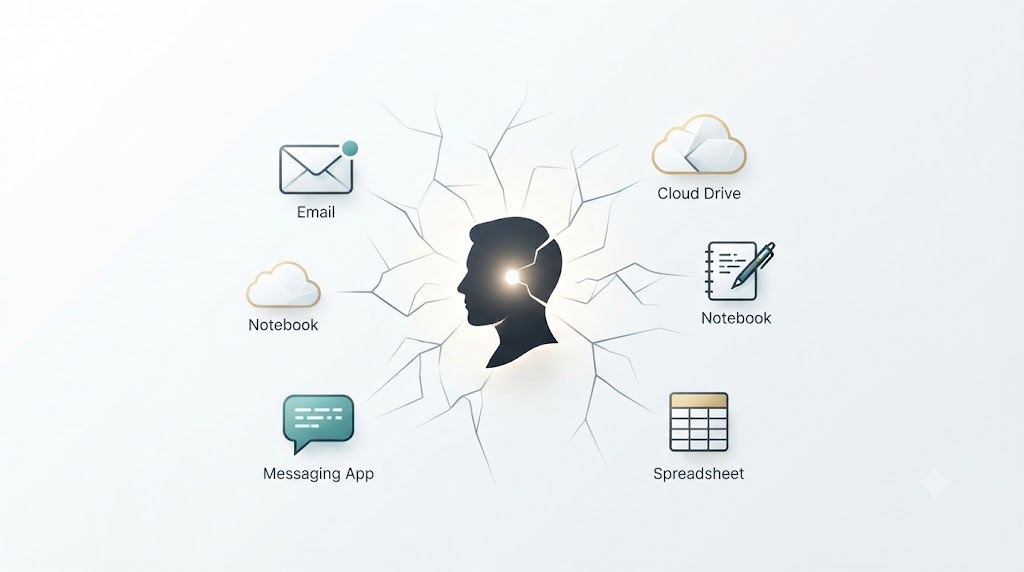
If your knowledge is already scattered across emails, cloud drives, WhatsApp chats, notebooks and people’s memories…

Adding one more place to store information doesn’t solve the problem.

It usually creates another place to search.

Before you organise anything...

Start by asking a simple question.

Where does our important information actually live today?

Not where it should live.

Where it really lives.

You might be surprised by the answers.

Pricing documents.

Client history.

Standard operating procedures.

Templates.

Meeting notes.

Decision logs.

How many different places would you need to check to find each one?

That exercise alone is often enough to reveal why people spend so much time looking for things.

AI has the same problem

This is one of the biggest reasons businesses struggle to adopt AI.

Everyone wants an AI assistant that can answer questions instantly.

But where is the AI supposed to get the answers?

If your business knowledge is spread across twenty different places—and some of it only exists in conversations or people’s heads—AI has exactly the same problem your employees do.

It can’t find what isn’t organised.

That’s why organising information isn’t just about becoming more efficient.

It’s one of the biggest steps towards becoming AI-ready.

A simple challenge

Take twenty minutes this week.

Grab a notebook or open a spreadsheet.

Now list your five most important types of business information.

Things like:

  • Pricing
  • Client information
  • SOPs
  • Process documentation
  • Templates
  • Key business decisions

Now write down where each one actually lives today.

Not where you wish it lived.

Where it really lives.

If finding the answers requires checking multiple places—or asking the same person every time—you’ve just identified one of the biggest sources of hidden friction in your business.

How organised is your business really?

Scattered information is usually a symptom of a much bigger issue.

Disconnected systems.

Undocumented processes.

Knowledge that’s trapped in people’s heads.

Teams relying on memory instead of documentation.

The challenge isn’t buying another app.

It’s understanding where the gaps are before you try to fix them.

That’s exactly why I created the Business Systems & AI Readiness Assessment.

It helps you evaluate how organised your business really is—from your documentation and SOPs to your workflows, knowledge management and readiness for AI.

By the end, you’ll know where information is getting lost, where your biggest operational risks are, and what to improve first.

If you want to build a business that spends less time searching and more time moving forward, it’s the perfect place to start.


👉 Take the Business Systems & AI Readiness Assessment


Oh hi there 👋
Nice meeting you here!

Sign up to receive useful content that you can actually use in your business every week.

We don’t spam! Read our privacy policy for more info.

Leave a Comment

Your email address will not be published. Required fields are marked *

This site uses Akismet to reduce spam. Learn how your comment data is processed.