Alistair Q Vermaak | I Build Scalable Systems

Can I ask you a question?

How many five-minute jobs happen in your business every day?

Not the big projects.

Not the client meetings.

I’m talking about the little things.

Updating the CRM.

Copying information from one system into another.

Downloading a report.

Sending the same follow-up email.

Renaming files.

Checking whether someone completed a task.

Most business owners don’t even notice these jobs anymore.

They’ve become part of the background.

Nobody complains about them because they don’t seem important enough to complain about.

After all…

“It’s only five minutes.”

But here’s what I’ve learned.

Five-minute tasks rarely stay five-minute tasks.

Small tasks have a habit of multiplying

One person spends five minutes updating customer information.

Then another person copies the same information into the accounting software.

Someone else updates a spreadsheet because that’s “how we’ve always tracked it.”

Individually?

No big deal.

Collectively?

You’re suddenly spending hours every week doing work that adds very little value.

And here’s the part most people miss…

The task isn’t really the problem.

The system behind the task is.

Your business grows... and so does the manual work

When you have ten customers, manual work doesn’t feel like much.

You can remember things.

You can fix mistakes quickly.

You can answer questions as they come up.

But what happens when you have a hundred customers?

Or a thousand?

Now every little manual task happens hundreds of times instead of ten.

More customers.

More staff.

More emails.

More handovers.

More opportunities for someone to miss a step.

The work doesn’t just grow with the business.

It grows with every new connection inside the business.

That’s why businesses often feel busier as they become more successful.

Not because the important work increased…

…but because the repetitive work quietly exploded in the background.

Time isn't the biggest cost

Whenever I point this out, someone usually says,

“But it only takes a few minutes.”

They’re right.

It does.

But I don’t think time is the real cost.

Opportunity is.

Every hour your team spends copying data, chasing information or repeating the same admin task is an hour they aren’t spending serving customers, improving your products or solving bigger problems.

That’s the hidden cost.

Not what the task takes.

What it stops you from doing instead.

Those little jobs quietly steal attention from the work that actually grows the business.

Before you CAN automate anything...

Everyone’s talking about AI and automation right now.

And don’t get me wrong—I love automation.

But here’s something I’ve learned over the years.

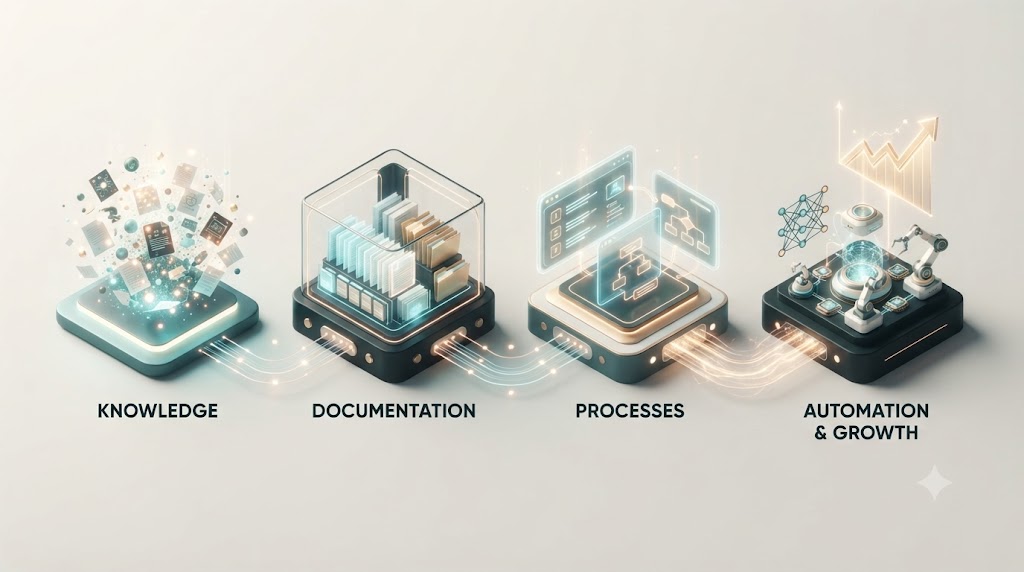
Automation isn’t the first step.

Understanding the process is.

If your workflow is confusing before automation, automating it simply helps you make the same mistakes faster.

The goal isn’t to automate everything.

The goal is to remove unnecessary work.

Sometimes that means automation.

Sometimes it means simplifying the process.

Sometimes it means asking a question nobody has asked before:

“Why are we even doing this?”

You’d be surprised how often nobody has a good answer.

Not every repetitive task deserves your attention

This is where people often go wrong.

They discover one inefficient process…

…and suddenly they want to automate the entire business.

Don’t.

Some tasks happen once or twice a year.

Leave those alone.

Instead, focus on the tasks that happen every single day.

The ones that grow every time you add another customer.

The ones multiple people keep repeating.

Those are the tasks quietly costing your business the most.

Here's a simple exercise

This week, pick one recurring task.

Just one.

Track it for five working days.

Write down:

  • How many times it happens.
  • Who does it.
  • How long it takes.
  • Why it exists.

Don’t try to fix it yet.

Just observe it.

Most business owners are surprised by what they discover.

Not because the task suddenly became more expensive…

But because it’s the first time they’ve actually looked at it.

The real goal isn't saving five minutes

It’s building a business where your team spends more time creating value and less time repeating work.

Those little manual jobs don’t usually feel urgent.

But they quietly grow alongside your business until one day everyone is busy…

…and nobody can quite explain why.

That’s when you realise the problem was never one five-minute task.

It was hundreds of them.

Is manual work slowing your business down?

Most businesses don’t have just one inefficient process.

They have dozens.

Some are caused by disconnected systems.

Some by undocumented workflows.

Some simply because “that’s how we’ve always done it.”

The challenge isn’t finding one manual task.

It’s understanding which ones are actually limiting growth.

That’s exactly why I created the Business Systems & AI Readiness Assessment.

It helps you evaluate how organised your business really is—from your systems and documentation to your SOPs, workflows and readiness for AI and automation.

By the end, you’ll know where your biggest operational bottlenecks are and which improvements will have the greatest impact.

If you’re serious about building a business that works smarter—not just harder—it’s the perfect place to start.


👉 Take the Business Systems & AI Readiness Assessment


Oh hi there 👋
Nice meeting you here!

Sign up to receive useful content that you can actually use in your business every week.

We don’t spam! Read our privacy policy for more info.

Leave a Comment

Your email address will not be published. Required fields are marked *

This site uses Akismet to reduce spam. Learn how your comment data is processed.