
The Bootstrapper's Dirty Secret
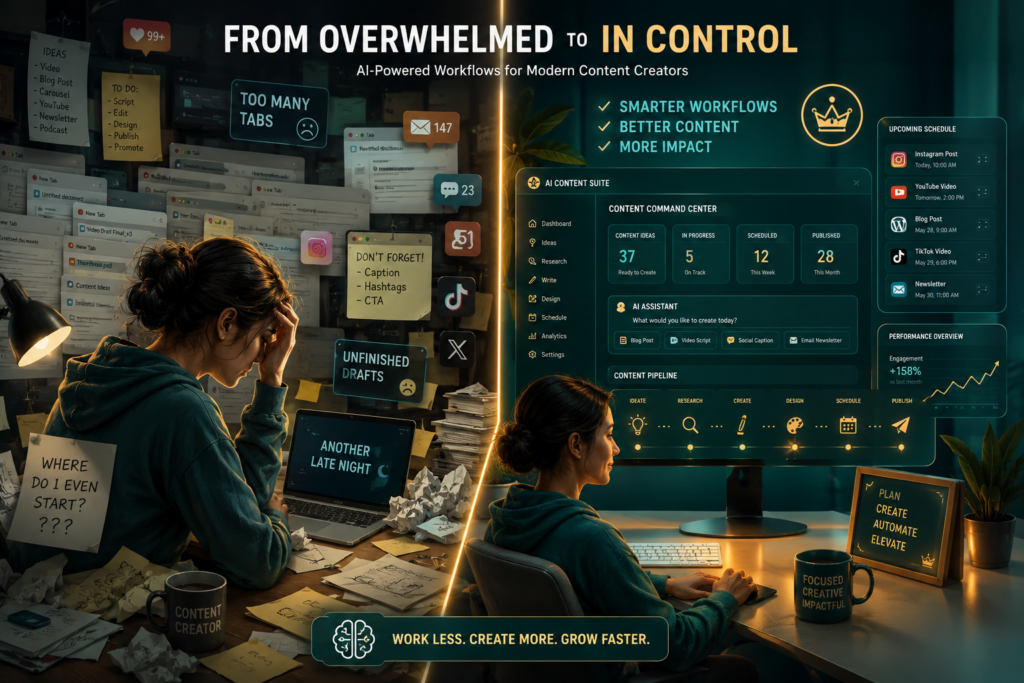
Let’s be honest about what running content as a solo business owner is like.
You have a blog post half-finished in one tab. An AI tool open in another. A Canva template you started three weeks ago still sitting in your drafts folder.
A podcast episode you promised your audience “coming soon” that hasn’t been recorded. A newsletter scheduled for Tuesday that’s now postponed to Wednesday evening.
Sound familiar?
Here’s the thing. You aren’t lazy. You aren’t bad at content. You aren’t missing some special gene that the mega-creators have.
You’re doing what every time-strapped, budget-conscious, trying-to-build-this-on-the-side founder does: you’re reacting instead of systemizing.
The bootstrapper reality is this: you have limited money, which means hiring a full content team is off the table. You have too many tools, because you signed up for twelve things and genuinely only using two of them. And your workflow is inconsistent, because when life hits — and it always does — content’s the first thing that gets dropped.
The result – You publish a burst of content for three weeks, go quiet for two, come back with a half-baked apology of an email to your list and repeat the cycle.
Your audience never gets used to hearing from you. Your traffic never grows. Your authority never cements.
AI increases content output significantly
Companies using AI publish 42% more content per month
But here’s the thing most content advice gets completely wrong about your situation.
It Isn’t the Tools. It’s the Lack of a System.
Every week a new AI tool launches that promises to change everything. Every week a creator posts a viral thread about the “10 AI tools that replaced my entire team.” And every week, solo builders download the tools, play with them for a day, feel briefly excited, and then watch them collect digital dust along with everything else.
The problem was never tool scarcity. We’re drowning in tools.
The problem is the absence of a repeatable system that tells you exactly what to create, in what order, using which tools, to produce which results — every single week — without having to reinvent the process every-time.
A traditional content team has roles: strategist, writer, editor, graphic designer, video editor, social media manager, SEO specialist, email copywriter.
Each role has a defined brief, a workflow, and deliverables. The team operates like a machine because each cog knows its job.
When you’re one person, you are all those roles. Which means, without a system, you default to whichever role feels most urgent — or most comfortable — on any given day. The result is an incomplete system that never delivers content consistently.
AI doesn’t fix that problem by itself. But AI inside a system? That changes everything.
What we need isn’t more tools. We need a content system — a structured, repeatable workflow where AI handles the heavy lifting of production, and you handle strategy, voice, and decisions. One where a single input ripples out into a week’s worth of content across every platform you care about.
That is exactly what this guide will show you.
Case Study: One Person + AI = 130 Blog Posts in 26 Weeks
Overview
A solo founder used AI tools to run a full content operation alone—no hires, no agency—just systems and leverage.
- Output: 130 blog posts in 26 weeks
- Team size: 1 person
- Tools: AI writing + SEO + internal linking systems
- Goal: Prove whether AI can scale content sustainably
👉 Read the full case study here:
26 Weeks. 130 Blog Posts. One Person With AI
What They Actually Did
Instead of “just using AI,” they built a structured system:
- Drip publishing cadence instead of bulk dumping content
- Each post optimized for EEAT (Experience, Expertise, Authority, Trust)
- Strong internal linking architecture to compound SEO value
- FAQ sections designed to capture featured snippets + AI search visibility
Result
- Consistent publishing over 6 months (no burnout cycles)
- Compounding SEO growth through structured content depth
- Sustainable solo workflow without hiring
The key insight is almost poetic: The bottleneck wasn’t writing speed. It was structure and consistency.
Your Content System: The Big Picture
Before we get into the tactical steps, here is the architecture you’re building towards.
The system has five layers:
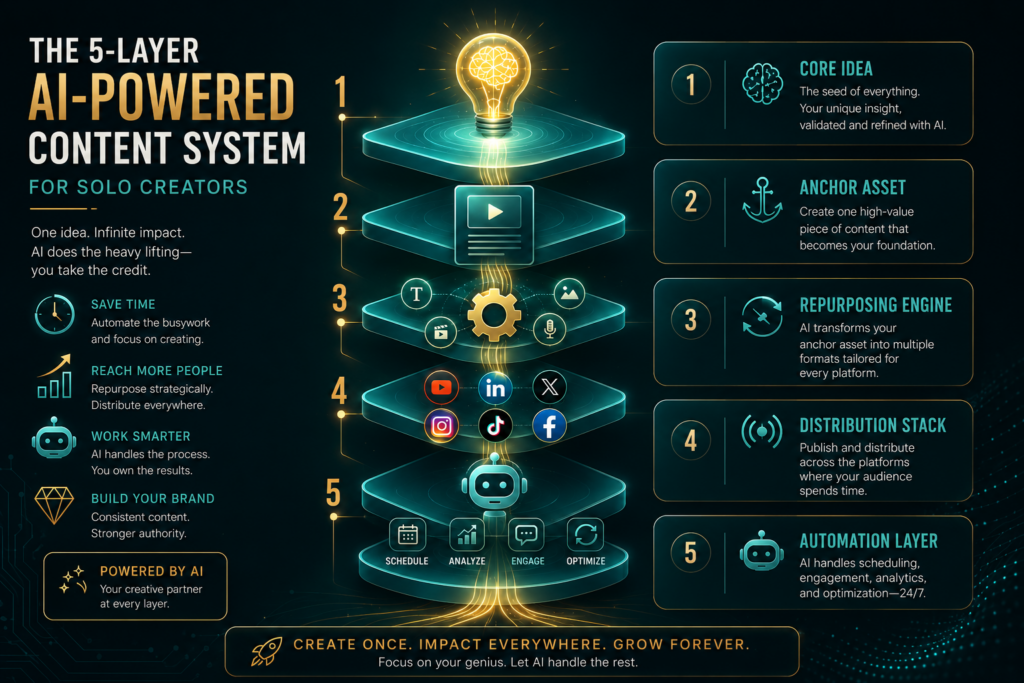
- Layer 1: The Core Idea: One focused topic per week, derived from a strategic content plan tied to your business goals.
- Layer 2: The Anchor Asset: One long-form piece — a blog post, a detailed video script, or an in-depth guide — that everything else is built from.
- Layer 3: The Repurposing Engine: AI-powered extraction and reformatting of your anchor asset into a suite of platform-specific content.
- Layer 4: The Distribution Stack: A defined list of platforms and formats where your content lands every week without fail.
- Layer 5: The Automation Layer: Tools that handle the repetitive publishing, scheduling, and formatting so your time stays focused on creation.
The beauty of this system is that it’s entirely front-loaded. The most creative, most strategic thinking happens once, at the start of the week — and then the system does the rest.
You aren’t a content creator grinding out posts. You are an editor running a lean, AI-powered workflow.
The Tactical Breakdown: Exactly How It Works
Here is the step-by-step system. Follow this sequence weekly and your content delivery process will be more productive than most three-person teams.
Step 1: Choose Your Weekly Core Topic (15 Minutes)
Every piece of content starts with a single focused topic. Not a broad theme — a specific question, pain point, or insight your audience is currently wrestling with.
Your topic sources:
- Questions from your community, email list, or DMs from the past week
- A keyword you are targeting for SEO or Pinterest
- A stage in your customer journey that needs a content touchpoint
- A trend or shift in your industry you have a perspective on
Once you have your topic, write one sentence that captures the core argument or insight. This becomes your creative brief for the week. Everything downstream flows from this sentence.
Example brief: “Solo founders are failing at content not because they lack tools, but because they have no repeatable system — this post gives them that system in five steps.”
Step 2: Build Your Anchor Asset with AI (60–90 Minutes)
Your anchor asset is your long-form content piece — the blog post, the YouTube script, or the in-depth guide. This is where you invest the most creative energy, because every other piece of content this week will be born from it.
Here is the AI-assisted creation process:
- Brief the AI with context
Paste your one-sentence brief and tell the AI your target audience, the tone you write in, and three to five key points you want to make. Ask it to produce a detailed outline.
- Review and reshape the outline
Do not accept the first output blindly. Add your personal examples, reorder sections that do not flow naturally, and inject your unique perspective. This is where your voice lives — not in the AI’s structure.
- Draft section by section
Use the AI to write each section in turn, feeding it the context of what came before. Paste in your own voice examples so it mirrors your style.
- Edit for authenticity
Read the full draft and replace any generic AI-ism with your own phrasing. Add a personal story, a hot take, or an insight only you would have. This step takes 20 minutes and is the difference between content that converts and content that gets skimmed.
Target length for a blog anchor asset: 1,500 to 3,000 words. For a YouTube script: 8 to 15 minutes of spoken content. The richer this asset, the more pieces you can pull from it downstream.
Step 3: Record Your Multimedia Content (30–45 Minutes)
Once your anchor asset is written, use it to record your video and podcast on the same day. You have already done the thinking. The script is done. Now you are simply delivering it.
The same-day rule is critical:
Record your YouTube video using your blog post as the script backbone. Then strip the audio for your podcast. You have now produced three content formats — blog, video, podcast — in under two hours of original creative work. This is where leverage begins.
Use AI tools to generate transcripts automatically from your recordings. These transcripts become a fourth raw asset that feeds directly into the repurposing step.
Step 4: The AI Repurposing Session (45–60 Minutes)
This is the center of your content system. With your anchor asset and transcript in hand, you now run a systematic AI repurposing session to produce every other piece of content for the week.
Here is exactly what you extract from one anchor asset:
- Email newsletter (1)
Prompt the AI: “Based on this blog post, write a 300-word email newsletter that opens with a relatable hook, delivers the core insight in plain language, and ends with a call to action to read the full post or reply with their biggest takeaway.”
- Short-form video scripts (3–5)
Identify the three to five most counterintuitive or emotionally resonant points in your anchor asset. Prompt the AI to write a 45 to 60-second hook-based script for each, formatted for YouTube Shorts, Instagram Reels, or TikTok.
- Pinterest pin descriptions (5–10)
Pinterest is a search engine. Ask the AI to generate keyword-rich pin descriptions for each major point in your post, formatted for discoverability. Pair these with Canva-designed pins for each.
- LinkedIn post (1)
Prompt the AI to write a LinkedIn post structured as a bold opening statement, three to five bullet insights from your post, and a question to prompt comments.
- Twitter/X thread (1)
Ask for a seven to ten tweet thread that unpacks the core argument of your anchor asset, with each tweet building on the last.
- Community questions (3–5)
Ask the AI to generate discussion questions based on your content for your WhatsApp group, Reddit, Quora, or any other community you are active in.
- Google My Business update (1)
A short 100-word post linking your content to a local or professional context, if relevant.
Important note on prompting:
The quality of your AI output is directly proportional to the quality of your input. Every repurposing prompt should include: the platform you are writing for, the tone you use, the length you need, and your audience’s specific pain point. A generic prompt produces generic content. A specific, context-rich prompt produces content that sounds like you wrote it.
Step 5: Schedule, Automate, and Distribute (30 Minutes)
With your content assets ready, your final step is getting them out into the world on a consistent schedule. This is where automation tools help you stay consistent, whther you’re sleeping or on holiday.
Your distribution system:
- Schedule your blog post to publish on your chosen day
- Upload your podcast to your hosting platform
- Schedule your YouTube video for the same publication day
- Queue your email newsletter in your email platform for the day after publication
- Schedule your LinkedIn post and Twitter thread for later in the week
- Upload your Pinterest pins with their AI-generated descriptions
- Post your community questions across Reddit, Quora, and your private groups
- Set your YouTube Shorts and Instagram Reels to roll out across the following week
Automation tools like n8n, Make.com, buffer, hootsuits, occoya, IFTTT and many more can handle a large portion of this distribution automatically — from publishing blog posts to triggering social posts to sending email sequences.
The goal is to make the publishing process as close to zero-touch as possible, so your creative energy stays where it creates the most value.
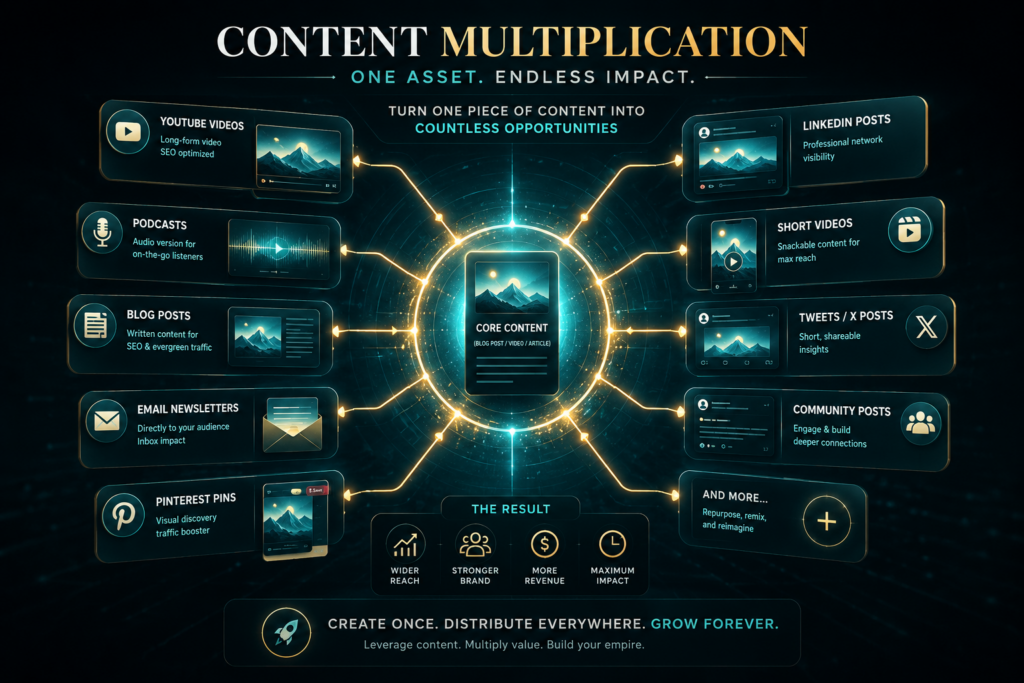
Output Multiplication: What One Piece of Content Actually Becomes
Let’s make this concrete. Here is a real-world example of what happens when you run this system for a single week’s topic.
Topic: How to Run a One-Person Content Team Using AI
Starting content: One long-form blog post (2,500 words)
What it becomes:
Asset Type | Volume | Platform |
Blog post | 1 | Website / SEO |
YouTube video | 1 | YouTube |
Podcast episode | 1 | Spotify / Apple |
Short-form video scripts | 4 | Reels / Shorts / TikTok |
Email newsletter | 1 | Sender.net |
Pinterest pins | 8 | |
LinkedIn post | 1 | |
Twitter/X thread | 1 | Twitter / X |
Community questions | 4 | WhatsApp / Reddit / Quora |
GMB update | 1 | Google My Business |
That is 23 content assets from one piece of long form content, produced in a single focused work day, using AI to handle the volume and you to handle the quality control.
Think about what that means at scale. If you run this system every week for a year, you publish 52 long-form blog posts, 52 podcast episodes, 52 YouTube videos, 208 short-form clips, 52 newsletters, 416 Pinterest pins, and hundreds of community touchpoints. You build a compounding content library that works for your business while you sleep, travel, or focus on your next product.
That isn’t a content strategy. That is a content system.
And the mechanics that make it possible aren’t complicated. They are just consistently applied.
The Mistakes That Kill This System Before You Even Start
Before you go build your content system, let’s be direct about the three failure modes that derail even the most motivated people.
Failure Mode 1: Skipping the Anchor Asset
When time is tight, the temptation is to skip the long-form post and just produce short content immediately.
Resist this.
The anchor asset is the strategic thinking that makes everything else coherent. Without it, your short-form content lacks depth, your email lacks authority, and your SEO gains nothing. The long-form piece is the investment. Everything else is return on that investment.
Failure Mode 2: Publishing AI Delivered Content Without Editing
AI is your production team, not your creative director. Unedited AI content has a particular texture that audiences sense even if they cannot name it: it is smooth, structurally sound, and completely devoid of the frictions and opinions that make human content magnetic. Your job in this system is not to write. It is to curate, edit, and inject personality. That 20-minute editing pass is non-negotiable.
Failure Mode 3: Building for Every Platform at Once
The output multiplication table above shows what is possible. It doesn’t mean you need to do all of it from week one. Start with two or three platforms that matter most to your traffic and revenue goals right now. Master the repurposing loop for those. Add platforms progressively as your automation handles the volume. A system you actually execute well on three platforms beats inconsistent posting on ten.
That's the System. Now Here Is What It Actually Takes to Run It.
If you have made it this far, you now have the design. You understand the five layers, you know the step-by-step process, and you can see exactly how one piece of content can become 20+ additional content pieces.
But let’s be honest: knowing a system and running a system are two different things.
The gap between “I understand this” and “I am executing this reliably every week” is filled by three things: the exact prompts that produce professional-quality repurposed content every time, the specific automation workflows that cut your distribution time from an hour to ten minutes, and the content strategy framework that ensures your weekly topics connect directly to your revenue goals — not just your pageviews.
I haven’t shared the prompts here — not because I’m holding back, but because they need to be built for your voice, your audience, and your specific business.
Generic prompts produce generic content. What you need is a prompt system calibrated to your brand.
The automation workflows depend on which tools you’re already running, which platforms matter most, and how far along your technical setup is.
And the content strategy that makes all of this purposeful — connecting topic selection to audience growth to product revenue — is the piece that turns a content system like this into a business asset rather than an endless content treadmill.
If you want the exact prompt library, the automation workflows, and the strategic content framework that powers this system — it’s all inside the Content Scaling System.
This is not a course. It is a plug-and-play content system for solo content creators — built for the bootstrapper who needs results without the fluff. The DIY version gives you everything you need to implement in a weekend.

Because here’s the bottom line.
The business running without you, location-independent life you are building doesn’t get funded by content you almost created. It gets funded by a content system that runs whether you are at your desk in Johannesburg or at a cafe in Lisbon.
Start the system. Run it for four weeks. Watch growth start happening.
FAQ
A one-person content team is a solo operator who manages strategy, creation, distribution, and optimization using systems and AI tools instead of hiring multiple specialists.
Not entirely. AI replaces production tasks like drafting, formatting, and repurposing. The human still drives strategy, positioning, and voice, which are the real differentiators.
With a structured system, one person can create:
- 1 long-form piece (blog/video/podcast)
- 10–20+ repurposed assets
per week without burnout.
An anchor asset is your main piece of content for the week (e.g., blog post or video) that everything else is derived from through repurposing.
Because they rely on motivation and ideas, not systems. Without a repeatable workflow, content becomes reactive and inconsistent.
It depends on your stack, but typically:
- AI writing (e.g., ChatGPT)
- Design tools (e.g., Canva)
- Automation tools (e.g., Make, n8n)
The tool matters less than how they’re connected in a workflow.
By editing. AI should generate the first draft, but you must:
- Inject personal insights
- Remove generic phrasing
- Add real examples and opinions
No. Effective repurposing means reformatting ideas for different platforms, not duplicating the same content everywhere.
You can build a basic version in a weekend, but it typically takes 2–4 weeks of iteration to refine into a smooth, repeatable workflow.
Treating AI like a magic button instead of a system component. Without clear inputs, structure, and goals, AI produces generic, low-impact content.