
The Button Everyone Pressed
Somewhere in 2023, stretching into now, almost every creator, founder, and brand strategist pressed the same button.
Generate.
The result was clean. Grammatically sound. Structurally fine. And completely, indistinguishably average.
Not because the tools were bad. Because the tools were too good at producing the median — and the median is just what already existed. Polished. Reasonable. Forgettable.
Here’s what nobody told you when they handed you the hammer: when everyone can produce professional-looking content in seconds, professional-looking content stops meaning anything.
This isn’t a complaint about AI. It’s an observation about markets. When the supply of something collapses in cost, its value moves somewhere else. It always does. The question is where it went — and whether you have any of it.
AI didn’t create a content crisis. It created a scarcity shift.
Content became abundant. Perspective became scarce.
The Real Collapse — And It Isn’t What You Think
Most people talk about AI content as a volume problem. Too much noise, too many posts, audiences tuning out.
That’s correct. It’s just not the deep part.
When Gutenberg’s press made copying books cheap, scribes didn’t lose work because books got too numerous. They lost relevance because reproduction — the one thing they were skilled at — stopped being scarce. Value shifted to selection, curation, and original thought.
The same shift is happening to knowledge work right now.
AI hasn’t made content production easier. It’s made it essentially free. And when something goes to zero cost, competing on production stops making sense overnight.
Most creators watched the cost of production fall — and responded by producing more. They doubled down on the exact thing that just stopped being valuable.
The New Scarcity
Here’s the part most “AI content strategy” advice skips:
AI is trained on what already exists. It’s the most sophisticated median machine ever built. It can assemble, recombine, and polish faster than any person alive. But it cannot originate a perspective it has never seen.
Yours is one of those.
Your specific mix of industries worked in, failures survived, clients misread, assumptions overturned — that’s genuinely irreproducible. Not because it’s special. Because it’s specific. It happened to one person, filtered through one set of values, in one sequence of events.
That specificity is the new scarcity.
And the standard AI content workflow eliminates it on purpose. Write me a post about X. Make it engaging. Add a hook. The machine complies happily. What comes back is fluent and empty of the one thing that would have made it worth reading — the friction of your actual thinking.
Information is transferable. Judgment is earned. AI can package information all day. It cannot earn judgment. Every piece of content you publish that leads with information instead of judgment is content sold at commodity prices.
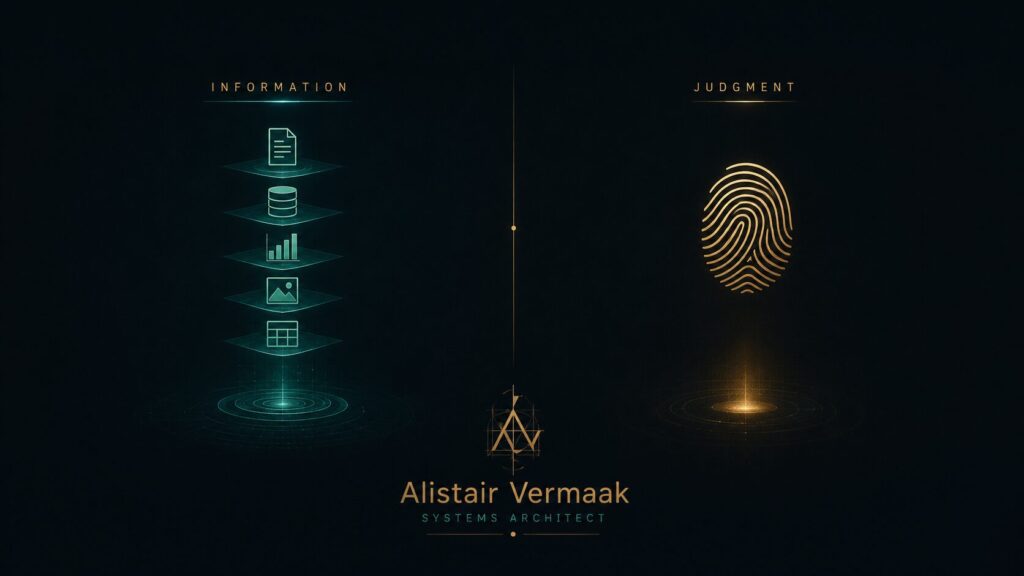
The Identity Split — Which Side Are You On?
There are two operating modes right now. Not businesses — individual creators and founders. Most people don’t know which one they’ve drifted into until the traffic numbers tell them.
Most creators are building noise when they think they’re building leverage. Map your current AI position and see which category you fall into here: alistairvermaak.com/assessment
Category A: The Output Maximiser
Treats AI as a production accelerator. The goal is volume — more posts, more formats, more touchpoints. The assumption is that showing up everywhere builds trust.
That worked when creation was hard and consistency was rare. Now the machine is infinitely consistent. A Category A creator is competing, on consistency, with something that never sleeps and doesn’t need to understand the audience to write for them.
That’s NOT a Strategy- if the only thing you have to show are good publishing numbers but absolutely rubbish growth metrics.
Category B: The Perspective Builder
Treats AI as a thinking partner — something to stress-test and structure ideas, not originate them. The perspective comes first. Production comes second.
The result reads like it came from someone with experience, not theory. Audiences feel the difference even when they can’t explain it.
Most people, honestly, sit between the two and are sliding toward Category A. Not from laziness — because the tool makes Category A frictionless. Staying in Category B takes active resistance.
The real question isn’t “Am I using AI?” It’s: Am I still creating Authentic Content or am I just Polishing AI Trash?
The Fracture Line
Nobody wakes up and decides to become another meaningless content creator. You drift there through small, reasonable decisions. The brief takes too long. The deadline is today. The AI result is good enough.
Then six months later, your best-performing post in years is the one you wrote in three hundred words from an airport about something that actually changed how you think. No AI. Just a thought and the intentional action of putting it into words.
By the time the data tells you what happened, most people are too deep in their own production line to hear it clearly.
The Five-Minute Test:
Before your next post goes out, run this. It takes five minutes and tells you which category you’re actually in.
- Pull up your last three published pieces.
- For each one, ask: could a competent stranger with no stake in this topic have written this exact piece?
- If yes for two or more — you’re publishing information, not perspective. That’s Category A, regardless of how good it looks.
- If no — find the sentence that only you could have written. That sentence is the actual asset. Everything else is delivery.
Do this monthly. The pattern shows up fast, and it’s a lot cheaper to catch the drift early than to rebuild trust after an audience has quietly stopped waiting for you.
The Pattern Behind the Pattern
Every major shift in media has followed the same arc. The printing press made text reproduction free — value moved to original thought. Photography made image reproduction free — value moved to artistic perspective. The internet made distribution free — value moved to trust and curation.
AI is making content production free. Value is moving to judgment and lived experience.
The pattern isn’t new. The speed is.
What never changes is this: the people who came out of each shift with lasting authority weren’t the ones who learned the new tool fastest. They were the ones paying attention to where value was actually going.
In your case, that’s your perspective.
Everything you’ve seen, built, broken, and rebuilt. The conclusions nobody else reached in quite that sequence, from quite that angle. That’s the asset. The tool is just distribution.
Hand the tool the job of originating that asset, and you’ve outsourced the one thing that made people want to follow you in the first place.
The Question That Actually Matters
It isn’t whether your content is good enough. The machine already solved good enough.
It’s whether it’s yours enough.
There’s a real gap between how people think they’re using AI in their content and how they’re actually using it. Most believe they’re building leverage. Plenty are building dependency — and the tell isn’t the quality of what comes out. It’s whether the piece would exist at all without the machine asking the first question.
I built a short assessment to make that gap visible. It takes about three minutes.
Find out which category you fall into: alistairvermaak.com/assessment“
FAQ Section
Is AI-generated content actually hurting traffic, or is this perception?
Both. Algorithmically, search engines are getting better at detecting synthetic signals — not just the text itself, but the absence of first-person authority cues, original citations, and the kind of specific, experience-backed detail that doesn’t appear in training data. More fundamentally, human audiences are developing faster pattern recognition for generic content. They may not name it, but they sense it — and they leave.
Does this mean I should stop using AI in my content process?
No. It means the sequencing matters. AI is exceptional at expanding, structuring, and refining ideas that have already originated with you. It is a poor substitute for the origination itself. The question is not whether to use it — it’s whether you’re still the starting point.
What does “perspective” actually mean in practical content terms?
It means the specific conclusions you have earned the right to hold — ones that come from direct experience, not synthesis. It means saying something that would be difficult or impossible to attribute to anyone else, because it required your particular sequence of events to arrive at. It means having opinions backed by evidence you gathered yourself, not opinions backed by what AI found credible to say.
What’s the counterargument? Isn’t volume still important?
Volume matters for reach. Perspective matters for retention and trust. The mistake is treating them as the same problem. A high-volume, low-perspective content strategy builds an audience that doesn’t know who you are — they just know they’ve seen your headlines. A lower-volume, high-perspective strategy builds an audience that waits for you. The compounding dynamics of the second are significantly stronger.
Who is most at risk from this shift?
Creators and founders who built authority through consistent information delivery — particularly in fast-changing fields like marketing, tech, and business strategy. If your audience followed you because you were reliably first with relevant information, AI has disrupted that advantage almost completely. Your next advantage has to be interpretive, not informational.
Who benefits most from this shift?
Deep domain experts, operators with real implementation experience, and anyone with a genuinely contrarian or hard-earned perspective. AI cannot replicate the authority that comes from having built something, failed publicly, and recalibrated. That category of person becomes more valuable in this environment, not less — because their perspective is irreproducible.
How do I know if I’ve drifted into Category A without realising it?
Honest answer: run the classification assessment. The structural tell is this — if your content could have been written by someone who has never done your work, never talked to your clients, and has no personal stake in the question, it probably was.
If this landed differently than most things you’ve read about AI and content lately — you’re probably sitting closer to Category B than you think. The assessment will confirm it (or challenge it): alistairvermaak.com/assessment