

Most Content Created Today Is Disconnected From Reality
Most people think the problem is the writing.
It isn’t.
I’ve read plenty of posts from small business owners and other content creators over the years. The writing is often perfectly fine. The grammar is good. The sentences make sense. Nothing jumps out as being wrong.
And yet five minutes later, I couldn’t tell you what the post was about.
Have you ever had that happen?
You read something. You nod along. Maybe you even agree with it. Then you move on and it disappears from your mind completely.
The strange thing is that the writing wasn’t bad.
The problem happened before the writing ever started.
The problem was perspective.
Content quality isn’t really about writing skill. Writing matters, of course. But writing is more like the vehicle. Perspective is the engine.
You can polish the paint, clean the windows, and make the vehicle look beautiful. But if there’s no engine under the hood, it’s not going anywhere.
The same thing happens with content.
When the perspective is clear, the writing becomes easier. The ideas connect. The examples make sense. Readers stay engaged.
When the perspective is missing, you’re left trying to polish something that never had much life in it to begin with.
Creating Content Is Easy – “Being Authentic” – that’s something else

The Content Trap: Creating More, Saying Less
A lot has changed in the last few years.
Thanks to AI, creating content is faster than it has ever been.
What used to take an hour can now take ten minutes.
At first, that sounds amazing.
And in some ways it is.
But there’s a catch.
Whenever something becomes easier and cheaper, people naturally produce more of it.
Think about photos.
When cameras were expensive and film had to be developed, people took fewer pictures. Today, everyone carries a camera in their pocket and thousands of photos get uploaded every second.
Content is going through the same thing.
Because it’s easier to create, more people are creating it.
The problem is that making more content doesn’t automatically make better content.
I see this all the time.
A business owner starts posting three times a week instead of once.
Then they start posting every day.
Then twice a day.
The volume goes up.
The results don’t.
Sometimes the results even get worse.
Why?
Because readers aren’t sitting around wishing there was more content to read.
There’s already more content than any of us could consume in a hundred lifetimes.
The real challenge isn’t creating content.
The real challenge is creating something worth paying attention to.
Imagine two people writing about the same topic.
Both write about productivity.
The first person says:
“Set goals. Stay consistent. Manage your time.”
Nothing wrong with that.
The second person says:
“Most productivity problems aren’t related to time. They’re related to drive and determination.”
Now we’re interested.
Same topic.
Different perspective.
One repeats what people already know.
The other helps people see something differently.
That’s the difference.
People aren’t starving for information.
They’re drowning in it.
What they’re looking for is insight.
What Is Perspective-First Content?
Most people start with a topic.
They decide to write about leadership, productivity, marketing, sales, mindset, or AI.
Then they sit down and try to think of something useful to say.
That’s the traditional approach.
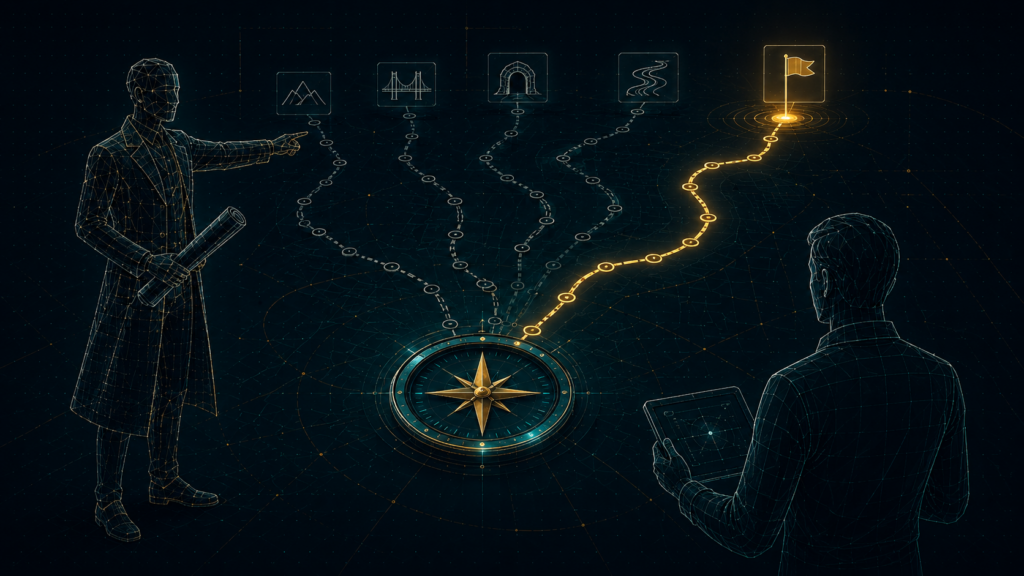
Perspective-first content works the other way around.
Instead of starting with the topic, you start with the lens.
You start with the way you see the world.
Then you apply that perspective to the topic.
The formula is simple:
Topic + Perspective = Insight
Let’s take productivity.
Most productivity content talks about time management.
But what if your perspective is that productivity is really about managing drive and determination?
Suddenly you’re writing a very different article.
Or take marketing.
Most marketing content focuses on tactics.
But what if your perspective is that marketing problems are usually about rules and red tape?
Again, completely different conversation.
Same topic.
Different lens.
Different value.
And here’s something important.
People rarely share information.
Nobody forwards an article to a friend because it contained a fact they could have found anywhere else.
People share articles because something clicked.
Because they suddenly understood a problem they had been struggling with.
Because they felt seen.
Because a light bulb switched on in their mind.
That click comes from perspective.
Not information.
Information vs Insight
This is where a lot of content gets stuck.
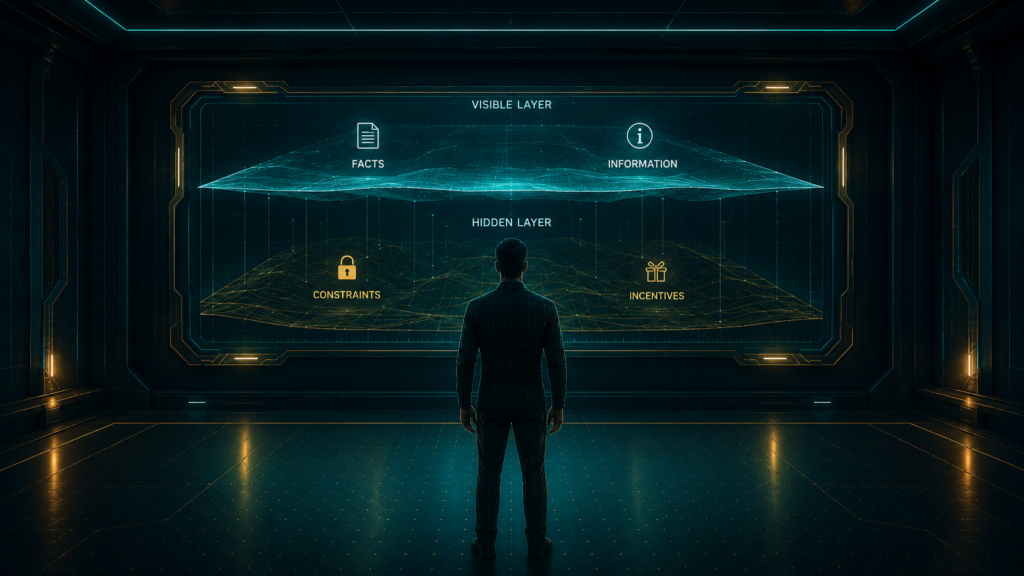
Information is useful.
We all need it.
Information answers questions.
It teaches facts.
It explains processes.
It tells people what something is and how it works.
But information is becoming easier to get every day.
Ask an AI tool almost any question and you’ll get information instantly.
Insight is different.
Insight changes understanding.
Insight helps someone see a familiar problem in a new way.
It’s the difference between telling someone what to do and helping them understand why they’re stuck.
Before you write anything, ask yourself two questions:
What does everybody already believe about this topic?
And:
What might they be missing?
The first question helps you understand the common view.
The second question helps you find your perspective.
If you can’t answer the second question yet, don’t start writing.
Keep thinking.
Keep observing.
Keep asking questions.
Because right now you don’t have a perspective.
You only have a topic.
And topics are everywhere.
Perspectives are rare.

The Four Layers of Content Creation
Most content never gets past the first layer.
That’s why it feels flat.
There are four layers.
Layer 1: Information
- These are the facts.
- The explanations.
- The basic knowledge.
- This is where most content starts.
And unfortunately, where most content ends.
Layer 2: Interpretation
This is where you explain what those facts mean.
- You’re helping readers connect the dots.
- You’re adding context.
- You’re making sense of the information.
Layer 3: Perspective
This is where things become interesting.
- Perspective is your unique way of seeing the subject.
- It’s the lens you’ve developed through experience, observation, and thinking.
This is where your content starts sounding like you instead of everyone else.
Layer 4: Transformation
This is the highest level.
Transformation happens when the reader sees something differently and changes what they do because of it.
- That’s the goal.
- Not just understanding.
- Not just agreement.
- Change.
The journey looks like this:
Information → Interpretation → Perspective → Transformation
Most content gets stuck at information.
The content people remember reaches transformation.

Why AI Makes Perspective More Valuable
Many creators worry that AI will make human content less valuable.
I think the opposite is happening.
AI is making perspective more valuable than ever.
Think about it.
AI can generate information in seconds.
- AI can summarise books.
- AI can explain concepts.
- AI can create outlines.
- AI can help with structure.
What it can’t do is live your experiences.
- It can’t notice the patterns you’ve noticed.
- It can’t spend years solving problems for clients.
- It can’t develop wisdom through trial and error.
Those things belong to people.
Which means the real value is moving away from production and toward perspective.
In the past, standing out often meant creating more content than everyone else.
Today, standing out means seeing something others don’t.
AI can help you express an idea.
But the idea still needs to come from somewhere.
And that somewhere is your perspective.
The creators getting the best results aren’t using AI to do their thinking.
They’re using AI to communicate their thinking more efficiently.
That’s a very important difference.

How to Develop a Perspective Before You Create Content
Whenever I’m working on a new piece of content, I usually follow a simple process.
Step 1: Identify the Surface Problem
What is everyone talking about?
What’s the obvious issue?
What’s showing up in conversations?
Step 2: Find the Hidden Mechanism
What’s actually causing the problem?
Not the symptoms.
The cause underneath the cause.
Step 3: Discover the Constraint
What’s stopping people from moving forward?
What’s the bottleneck?
What’s getting in the way?
Step 4: Build Your Lens
What principle explains what you’re seeing?
What pattern keeps appearing?
What connects all the dots?
Step 5: Create the Content
Now write.
Not before.
Now.
Because now you have something worth saying.
This is exactly how I developed the Constraint Map.
I didn’t wake up one morning and decide to build a diagnostic tool.
I kept seeing the same patterns:
People weren’t failing because they lacked motivation.
Many of them were highly motivated.
The real issue was somewhere else.
- Some struggled with judgment.
- Others struggled with systems.
- Others struggled with execution.
Once those patterns became clear, the framework emerged naturally.
The lens came first.
The content came afterwards.
That’s usually how it works.
The Perspective-First Checklist
Before publishing anything, ask yourself five simple questions.
- What assumption am I challenging?
- What hidden mechanism am I revealing?
- What misconception am I correcting?
- What pattern have I noticed repeatedly?
- What changes once someone sees this differently?
These questions force you to move beyond information.
They force you to think.
And if you struggle to answer most of them, that’s usually a sign that the piece needs more work.
Not more writing.
More perspective.
Two Articles. One Topic.
Let’s use procrastination as an example.
Everyone talks about procrastination.
Most articles sound similar.
- They focus on time management.
- Goal setting.
- Productivity tricks.
- Morning routines.
Nothing wrong with those ideas.
But they often miss something.
A perspective-first approach might ask a different question.
- What if procrastination isn’t a motivation problem?
- What if it’s an uncertainty problem?
- What if people aren’t avoiding the work because they’re lazy?
- What if they’re avoiding it because they don’t know what the next step is?
Now we’re looking at the same problem through a different lens.
The solution changes.
The conversation changes.
The value changes.
One article teaches.
The other transforms.
And that’s the goal.
The same thing is happening with AI content right now.
One person publishes a list of ten AI tools.
Another asks why businesses are using AI to speed up old processes instead of rethinking how the business should work in the first place.
Same topic.
Different perspective.
One is information.
The other is insight.

The Shift
The future doesn’t belong to the people who create the most content.
It belongs to the people who help others see something they couldn’t see before.
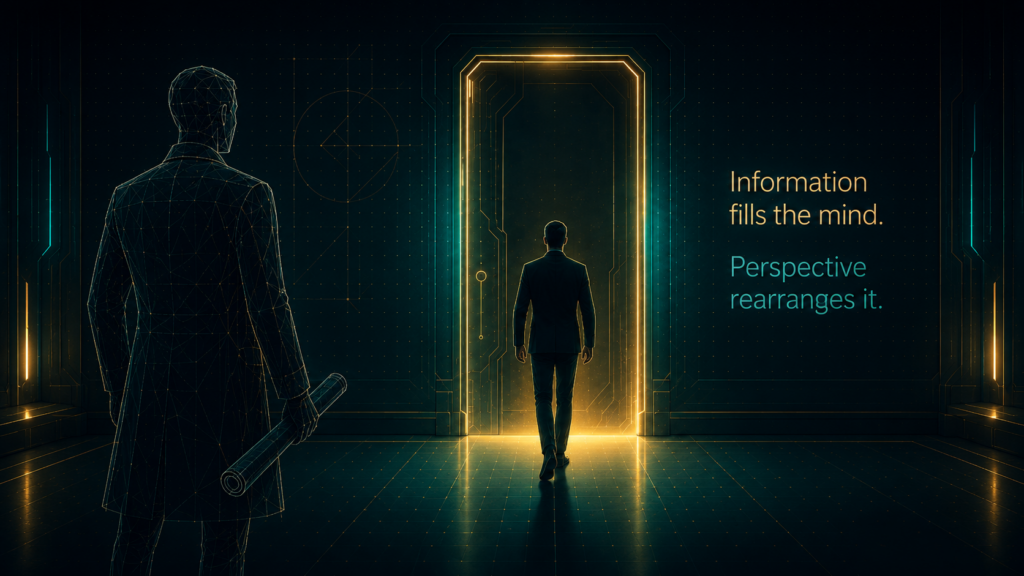
Information fills the mind.
Perspective rearranges it.
One adds knowledge.
The other changes understanding.
And understanding is what people remember.
Before You Write Your Next Piece
Before opening a blank document.
Before asking AI for an outline.
Before choosing a headline.
Pause for a moment.
Don’t ask:
“What should I write about?”
Ask:
“What do I see that others are overlooking?”
That’s the question that matters.
That’s where insight begins.
That’s where memorable content begins.
And that’s where perspective-first content starts.
Everything else is just the packaging.
Find out where your business
is leaking time and momentum.
Run Through a diagnostic page where you can self identify places where your business might be stuck. Then go on to complete 20 questions across 4 dimensions. Scored instantly. Provide your email and we'll personally review your score breakdown and send you a written recommendation and next steps specifically based on your numbers — with one concrete action to take this week.
5 minutes · Free · Instant results
Related Videos & Podcast
FAQ
Q1: What does “perspective-first content” actually mean?
A1: It means starting with a specific way of seeing a topic before you write anything, instead of picking a topic and hoping something useful shows up while you write. The formula is simple: topic plus perspective equals insight.
Q2: Why isn’t writing skill the main problem with forgettable content?
A2: Because plenty of well-written content still gets forgotten. Clean sentences and good grammar don’t create memorability on their own. What makes content memorable is a perspective the reader hasn’t run into before — the writing is just how that perspective gets delivered.
Q3: How has AI changed what makes content valuable?
A3: AI made information and basic expression cheap and instant. That means information alone is no longer worth much. What’s still scarce is a lens built from real experience — something AI can’t generate on its own because it hasn’t lived through anything.
Q4: What are the four layers of content?
A4: Information, interpretation, perspective, and transformation. Information is the facts. Interpretation is what those facts mean. Perspective is a distinct way of seeing the subject. Transformation is how that perspective changes what the reader does next. Most content stops at the first two layers.
Q5: How do I find a perspective on a topic that’s already been covered many times?
A5: Run it through a five-step process: identify the surface problem everyone’s discussing, find the hidden mechanism causing it, identify the one real constraint blocking progress, build a lens from that constraint, and only then create the content.
Q6: What’s the difference between information and insight?
A6: Information answers a question and gets copied easily — any AI tool can produce it instantly. Insight changes how someone understands a problem they thought they already understood. Insight is what gets shared and remembered.
Q7: How do I know if my content has a real perspective or not?
A7: Ask whether ten other people in your space could have written the exact same piece. If yes, it’s likely stuck at the information or interpretation layer. If there’s something in it only you could have said, based on something you’ve actually noticed or lived through, it’s reached the perspective layer.
Q8: Does posting more content help if it doesn’t have a clear perspective?
A8: Not usually. When content production gets cheap, people tend to make more of it without making it better. Volume without a lens tends to flatten results rather than grow them.
Q9: What’s a quick test to run before publishing a piece of content?
A9: Ask five questions: what assumption am I challenging, what invisible mechanism am I revealing, what misconception am I correcting, what pattern have I noticed repeatedly, and what changes once someone sees this differently. If most of these go unanswered, the piece is probably still at the topic stage, not the insight stage.
Q10: Is procrastination really about decision-making rather than motivation?
A10: In a lot of cases, yes. What often looks like low motivation is actually decision friction — not knowing the specific next step, which leads to avoidance that looks like procrastination from the outside.